Showing posts with label Literary Road Trip. Show all posts

30 November 2010

Spotlight On . . . Carol Larese Millward

Welcome to the Literary Road Trip and my Spotlight On . . . Carol Larese Millward. Even though we live in an age when premarital sex is common and perhaps assumed, teen pregnancy is an issue that is as life-changing as it has always been. Carol's novel Star in the Middle addresses teen pregnancy from both the young mother's and the teen father's points of view.

Although Carol now lives across the border in Maryland, she is definitely a Pennsylvania author. Both she and her husband were born and raised here, and they have deep ties to the state. Carol became interested in teen parents when she began working with them as part of her job. Take a moment to get acquainted with Carol.

Pennsylvania: Back Again One Day

I grew up in Pennsylvania, and my husband and I now own a house along the Juniata River. We plan to escape there often after he retires, to visit with family in the area and in Cambria County.

I like to believe that my desire to write came to me, at least in part, from living on an old country road with violets and Johnny jump-ups growing along a tiny stream bank in the spring and beautiful foliage exploding everywhere in the fall. I remember brilliant shades of green in the summer, and layers and layers of crusted white snow in the winter—and that moon! Okay, I know it’s the same moon that rises over my current home in Maryland, but memories of my childhood Pennsylvania moon are larger than life—as is the whistle that summoned my father to his job deep in the coal mines with other Pennsylvania miners. (A story about my father entitled "Whistle Prayers" has appeared in Pennsylvania Magazine, as well as several other publications, and can be found on my website.)

I’ve always been a writer, but truthfully, writing a novel about teen parents was never on my radar. I literally got talked into working with pregnant teens and teen parents at one of Maryland’s family centers, testing and tutoring them as they prepared to take GED classes. Although I felt ill-prepared to work with young adults, after having worked with preschoolers for many years, I soon found that I loved working with young families. I started incorporating parenting topics into their writing assignments and talking them through their voiced concerns and challenges as they learned to parent their babies. I was then asked to teach parenting classes and trained in two parenting curricula.

Star in the Middle started as a character sketch that I wrote for a writing class. That assignment helped me to focus on the difficulties teen mothers face as they attempted to complete their educations and raise their babies, often without the support of their babies’ fathers. The assignment got tucked away, but every time I found myself concerned about rising teen pregnancy statistics, I vowed to write a novel about the difficulties pregnant teens and teen mothers face.

When I finally sat down to write Star in the Middle, I felt like I knew the characters personally. Their voices were in my head, and it was their voices that told their stories. Star, the teen mother, had a very strong voice, but Wilson, the teen father, wanted his voice heard as well. Although I never intended to write a novel in dual voices, I soon found that his was a voice that could not be ignored. In retrospect, I see that this was the novel I intended to write all along, and even though Baby Wil was not old enough to talk at novel’s end—I felt he had a voice as well.

Star in the Middle is a story about a girl who has a secret. Star’s secret, in fact, has been identified as a factor in putting girls at a higher risk of becoming teen mothers. It’s also a story about a boy who is privileged and who is forced to face some facts about himself and the mother of his baby—a baby that he denies is his, even to himself.

I hope that readers will find the suspense in Star in the Middle exciting, the characters both likable and engaging, and their stories compelling. I also hope the novel will demonstrate the importance of young adults protecting themselves against unplanned pregnancies and STDs.
_______

Thank you so much, Carol. There are couple of things about your novel and your guest post that interest me. First, teen pregnancy continues to be an issue, even in this day of easy access to reproductive information and birth control. I think many people tend to forget that. Second, I am sure your personal experience of working with young parents has brought an authenticity to Star in the Middle. Finally, I love that you have included the father's voice. So many teen pregnancy books and movies leave the young father's issues out of the story.

Oh and I just love the photos Carol shared of the Pennsylvania countryside. I'm glad she's kept her Pennsylvania roots close to her heart.

Star in the Middle at Powell's
This link leads to an affiliate program.


Carol Larese Millward is a writer who for several years was a family advocate and parent educator working with teen parents through Family Support and Education Centers. She is a member of the Society of Children’s Book Writers and Illustrators, and when she isn’t writing, Carol enjoys spending time with her two children and their families, which include six grandchildren. She lives in Maryland with her husband of 40 years and their two cats. Star in the Middle is her debut novel.

To learn more about Carol, to read her short story, and to see the book trailer, visit her website.

Thanks to Jenn of Jenn's Bookshelves for hosting this fabulous project. For more Literary Road Trip posts from around the world, visit the LRT page.

Click for more

19 October 2010

Spotlight On . . . Libby Cone

Welcome to the Literary Road Trip and my Spotlight On . . . Libby Cone. I am very excited to introduce you to Libby and to her novel War on the Margins. As I have mentioned repeatedly a few times, I did my doctoral research in Guernsey and thus have a soft spot in my heart for the Channel Islands.

As most of you know by now, the Channel Islands were occupied by the Germans during World War II. What many of you may not know is that persecution of Jews was no less present there than on the Continent.

In an odd kind of coincidence or convergence of . . . well, something, Libby and I have much in common. We both started out life in the sciences, we both ended up in the book world, and we both focused our research on the Channel Islands.

Libby concentrated on Jersey, and her book War on the Margins features documents and letters dating from the war and explores the lives two Jewish artists, Claude Cahun and Marcel Moore, who lived together, hiding their true relationship by saying they were stepsisters. They were extremely active in the Resistance in Jersey, and their story is amazing.

Libby talks about how she came to be an author.

The Road to Reinvention

I have lived in Philadelphia, Pennsylvania, for twenty years, having moved here from Boston in 1990 to do a nuclear medicine fellowship at Penn. Had anyone told me that I would be thinking about writing a novel ten years later, I would have laughed. But Pennsylvania has been a great place of transition and reinvention for me. When I first arrived, it took a while to become acclimated, to stop pronouncing the first "l" in "Schuylkill," to realize that Broad Street was Fourteenth Street, to eat a soft pretzel. But I also began my career here, at the late lamented Graduate Hospital in 1991, and my roots began to grow.

I think being away from the scrutiny of family and others who have settled expectations can be a very good thing in one's growth as an adult. I surprised myself with my own readiness to embrace a career after so many years of training. The harder lessons came later, as I found myself in the middle of the 1997–1998 Allegheny debacle, when a large Pittsburgh-based healthcare system with a ruthless and arrogant CEO took over the Graduate system, only to go bankrupt a year later. That was when I realized that it was power politics, and not merit, that ruled the day. I learned, probably later than most, that people in expensive suits could look me in the eye and lie; that money and power trump quality and altruism; that no good deed goes unpunished. Yes, I am thin-skinned.

Fortunately, I was an early user of the Internet, and this brought me my husband, a guy from Lansdale, who is still the most straightforward and unpretentious individual I have ever met. Philadelphia was (and is) the hotbed of progressive Judaism, which also began to draw my interest. I realized that, as far as the suits in the administrative offices were concerned, my career was just a job like any other. I sought something more meaningful. I began to take Adult Ed courses. Then I matriculated as a part-time graduate student in Jewish Studies at Gratz College in Melrose Park while working mostly full-time as a radiologist.

I was looking up Manx cats on the Internet one day when, instead of finding the Isle of Man, I ran across the Channel Islands and saw some information about their occupation by the German forces during World War II. Being as stubborn as I am thin-skinned, I delved into this little-known story of the Holocaust in microcosm. When I found I was boring everybody at lunch with the topic, I knew it was thesis material. My adviser, who doubtless plows through many doorstop dissertations, suggested I do an offbeat treatment. Thus the idea of the novel was born.

No doubt as I was reinventing myself as a writer, I was identifying with the Surrealist artists Claude Cahun (Lucille Schwob) and Marcel Moore (Suzanne Malherbe), who, at a similar age, were reinventing themselves as Resistance propagandists on the occupied Island of Jersey. They, too, were resentful of bureaucracy, which, in the case of the occupation, was the tool used to control the Islands' inhabitants and to single out and further oppress the handful of remaining Jews.

War on the Margins became the poster child for self-publishing. A few months after I self-published the paperback, I heard from a British publisher. The hardcover was brought out in the UK, and the e-book in the United States, by Duckworth in 2009. Writing is still not paying the bills, but in terms of career satisfaction, it is endlessly exciting. While I still enjoy reading CT scans, the possibilities of a blank Page 1 in an Office document never fail to thrill me.
_______

Thanks so much, Libby. It is fascinating to me how you stumbled across the German occupation of the Channel Islands and how you couldn't turn your back on the story of these women and the Jewish population of Jersey. The letters and documents found throughout your novel bring the stark reality of the occupation to light. Look for my review of War on the Margins in the next couple of weeks.

Photos: The photos of Moore and of Moore and Cahun's tombstone are from Libby Cone. The photos of a German bunker by the sea and a German-built silo in a field (click to enlarge) were taken by me in 1983 (scanned from slides; sorry about the quality). The German presence was still very much felt in the 1980s.


War on the Margins at Powell's
War on the Margins at Book Depository
These links lead to affiliate programs.

War on the Margins has been nominated for a People's Book Prize.

Libby Cone earned an MA in Jewish Studies in 2006 and War on the Margins grew from her thesis. She lives in Philadelphia.

Click for more

14 October 2010

Spotlight On . . . Kate Ledger

Welcome to the Literary Road Trip and my Spotlight On . . . Kate Ledger. You have heard me talk about Kate before because her book, Remedies, was published as an Amy Einhorn Book, an imprint that I strongly recommend to my readers.

Since I first featured Remedies, the novel has gone on to be an August 2010 Indie Next Pick, a book club selection for Self magazine, and the community read for the Twin Cities Jewish Book Fair.

Kate is a Pennsylvania author through and through. She was born and bred in the Philadelphia area, and the city not only plays a role in her novel but has the power to seduce her into taking a walk on the wild side.

Bringing It All Back Home

I was born in Philadelphia, and I lived there until I was almost twenty-two. I still come back to visit, but I haven’t called Philly home for nearly twenty years. The truth is, however, the places you live leave their marks on you. They stamp you with their nuances and their vibes. And if it happens you’re a fiction writer, some of those marks creep up in surprising ways as they make appearances in your work.

Remedies takes place in Baltimore, where I was living at the time I began writing the book. But Philly is present in the story. Remedies is the story of a complicated Baltimore family that’s on the brink of falling apart, but Philly appears as the city of escape, where reunions take place that put characters in touch with their pasts. It’s the site of confusion, of recognition. It’s the site of potential change, of falsified hope, and the desire to recreate one’s circumstances and identity.

I can explain how I envision the writing process, at least the process of writing fiction. You take a topic you’re interested in, and you begin to ruminate about it. There’s a great swirling of things you know and that you’ve experienced, of people and voices, some of which make sense and some of which appear only tangentially relevant. The visual description of it, in my mind, is Dorothy sitting in her house caught in the cyclone. She’s looking out the window and pieces of her life are floating by: Auntie Em in a rocking chair, a cow, some familiar people in a rowboat, Miss Gulch on the bicycle who then transforms into a witch. In the writing process, all swirling outside the window makes sense because it’s familiar, but the pieces are unmoored, and out of context.

The beauty of writing—of creating—is that moment of reaching out the window into the cyclone to grab what’s floating by. You’re telling a story, but the components come from both the conscious and the subconscious. The pieces don’t make sense, at least not in a linear, rational way. As you write, and you fit some of these fragments together, you take note of some of the connections. Other connections you understand later, after the book is done. I heard a memoirist give a talk recently in which he said, “As you write about your life, you discover your stories.” The opposite seems to me to be true about fiction: As you write fiction, your stories discover you.

I wasn’t thinking consciously about Philly as I was writing; at least, I wasn’t thinking: Hmm, Philly, what does it mean to me? I put a character on an Amtrak train and let her get off at 30th Street Station. Ultimately, she has an affair in the city that makes her discover some truths about her life. In hindsight, long after I’d finished writing the book, I remembered one afternoon in my own life history—an afternoon on a Philly street—when I’d sought a kind of transformation. My own story was much more innocuous than my character’s, but similar in the themes of finding oneself.

It was the mid-1990s. I no longer lived in Philly, but had come back to visit my parents as a twenty-something. I had a job I was uncertain about. I was single and eager to fall in love. I was intent on becoming a fiction writer, but hadn’t yet begun to write a book. I was trying to figure out my life and who I was, what sorts of things represented me, and, in turn, how I represented the things I cared about. That same weekend I was in town, my brother, two years younger than I am, happened to be visiting, too. His life was in similar stage of taking shape. He told me he was thinking about getting a tattoo. What I’d been thinking about was getting my navel pierced.

During our teenage years, in the 1980s, South Street in Philadelphia had been on fire with alternative culture. For an eight-block stretch on the east side of downtown, punk fashion raged with dramatic style: leather chokers, studs, Mohawks, fishnets, high-top boots, dyed hair. As teenagers, my brother and I had been equally non-flamboyant in our style, but we’d often ventured to South Street to buy tapes and posters and to marvel at the boldness of punk style. But that particular weekend a decade or so later, as we returned to Philly, we were struck with the desire to recreate ourselves with symbols that still felt daring and alternative. We drove across town to South Street to stamp ourselves with something new.

The neighborhood was still much as we remembered it, a crowded avenue of colorful storefronts, and we found a few tattoo parlors where we looked through artists’ samples. They were intriguing, fanciful, and bold. The fact about a tattoo, though, is you have to know what message you want it to convey about you. I could see in my brother’s face that neither Tweetie Birds nor Chinese characters seemed to hold enough meaning. We wandered further down South Street and went into a store to ask about the price of navel piercing. But I, too, began to feel uncertainty about what exactly I was trying to say with the gesture.

After a while, having made no decisions, we headed to a rooftop lounge and ordered drinks. The street looked cartoonish from up above. We had a good time talking, and soon the afternoon sun was fading. We both acknowledged it was too bad we no longer both were living in the same city, especially both being twenty-something, unsettled, and uncertain about what was coming next in our lives. It was clear as we sat there neither of us was getting tattooed or pierced that day. But it was also clear some other transformation had taken place. The afternoon had resulted in a kind of growing up—the kind you experience when you take note of where you are in your life, when you recognize you’re not alone in what you’re feeling, and when you realize that things, however they turn out, will probably be okay. We drank a few beers and went home.

Recently, I reminded my brother of that afternoon, and he grinned appreciatively about The Day We Went to South Street and Nothing Happened. Philly was where I experienced a lot of things. It was the city where my heart was first broken by a boyfriend. It was where I began writing about medicine, which became the focus of my career as a magazine writer. The city is symbolic of a multitude of things to me, but I discovered in the process of writing a work of fiction that self-discovery is among them. (It might be interesting to know that, for yet another character in the novel, navel-piercing figures prominently, too.)
_______

Thank you so much, Kate. I love the analogy of the debris flying by the windows in The Wizard of Oz. I also love the story of your visit to South Street. I can picture you two taking a look at your options; playing with the idea of getting a little crazy; and then going somewhere to have a drink, catch up on your lives, and do some people watching. What a great memory. (Photo credits: the ants on the old Zipperhead store and the mosaic from South Street by David Saddler; South Street buildings by Eric Hart. Click on the images to enlarge.)

Here is a short video in which Kate introduces us to Remedies:


Kate Ledger grew up in Philadelphia and graduated from Akiba Hebrew Academy and the University of Pennsylvania. She received a Master of Fine Arts degree in fiction from the University of Arizona. She lives in St. Paul, MN, with her husband and children. To learn more about Kate, visit her website.

Remedies at an Indie
Remedies at Powell's
Remedies at Book Depository
These links lead to affiliate programs.

Click for more

05 October 2010

Spotlight On . . . Mariah Stewart

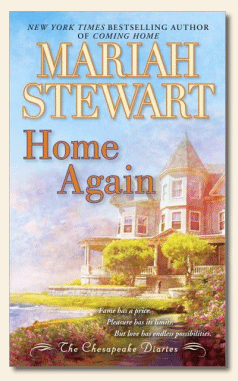
Welcome to the Literary Road Trip and my Spotlight On . . . Mariah Stewart. Mariah's newest book in her Chesapeake Diaries series is Home Again, and it is currently on a book blog tour.

Although her Chesapeake books are, of course, set in Maryland, they really aren't so far afield from Mariah's country home. Here's how she found her perfect place.


The Best of All Worlds

I was born in Philadelphia, but before I turned two, my family moved to central New Jersey, back when New Jersey really was the Garden State. There were fields and woods behind our house and a farm down the road. Is it surprising that I feel more at home surrounded by fields and woods than I do city streets and tall buildings?

When I moved back to PA as an adult, I lived in a pretty little town with lots of Victorian houses and wide streets in Philadelphia’s outer circle. I loved that town—still do—but once our daughters left for college, my husband and I wanted some respite from the congested highways and pollution and stress of living so close to the city. We both love the country, so it was natural for us to begin our new home search in Chester County.

We built the house of our dreams upon an acre of ground that was once part of the farm where Thomas McKean—a signer of the Declaration of Independence—was born. That fall, while the house was being built, we spent almost every Sunday exploring all the little side roads and driving those endless miles of beautiful Pennsylvania farmland.

That’s how we came to be driving past a pretty little farm one Sunday afternoon—a farm with a barn from which emerged fifty or sixty people of all ages, all in Amish garb. We had no idea that the town of Oxford, the largest town in this part of Chester County, had a large Amish population, or that many of the farms between our home and Oxford were Amish owned.

Since then, we’ve gotten to know several farmers and their families quite well, and we’ve become frequent visitors to their farms where, in season, we buy all our fruits and vegetables, eggs and dairy products (my husband, a nutrition counselor and proponent of organic and natural foods, thinks he’s died and gone to heaven, as my mom would say!). We’ve watched their children grow from babies to schoolchildren, others from adolescence to adulthood. We’ve watched just-born calves stand for the first time in their fields, and little piglets romp like puppies in their barns.

It’s been one of the happy surprises of living here, but not the only one.

Here in southeastern PA, we’re really close to the Chesapeake Bay, one of my all-time favorite places. St. Dennis, where I’ve set the Chesapeake Diaries, is a composite of several of those charming little towns that dot the bay’s shores. Inspiration is only a half hour away when I need it, and my country home is waiting for me when I return. Farm-fresh produce on the one hand, fresh seafood on the other: for foodies like us, that’s the best of both worlds. I count my blessings every day!
_______

I am clearly living in the wrong area of Pennsylvania. Chester County is a beautiful part of the state, and indeed it is known for its picturesque farms and wonderful produce. And less than an hour from the bay? Yes, you are in heaven. (Photo credits: Chester Co. farm and Chesapeake Bay from Wikimedia; in the public domain.)


Mariah Stewart is the award-winning New York Times and USA Today bestselling author of twenty-seven novels of contemporary romance and romantic suspense. A native of Hightstown, New Jersey, she lives in southern Chester County, Pennsylvania, with her husband, their daughter, and their dogs.

To learn more about Mariah, visit her website or her Facebook page.

Click for more

30 September 2010

Spotlight On . . . Joyce Hinnefeld

Welcome to the Literary Road Trip and my Spotlight On . . . Joyce Hinnefeld. When I had the pleasure of meeting Joyce at BookExpo America (BEA) this last May, I discovered that she lives in eastern Pennsylvania. That gave me the opportunity to introduce her to all of you. Joyce's second novel, Stranger Here Below, was published just this week by Unbridled Books.

Today Joyce wonders about her own connection with place. Are authors always objective observers, standing to the side? Or can their characters pull them into the circle and welcome them home?

Writing from the Outside

For someone whose fiction almost always springs from engagement with a place, I find it surprisingly hard to identify myself with one specific geographic locale. How can I write about being a Pennsylvania writer, I’ve been wondering as I’ve pondered this blog post, when I don’t really consider myself a Pennsylvania anything? Nor an Indiana writer, nor a Chicago writer, nor an upstate New York or New York City or Kentucky writer—to name some of the places I’ve lived, or written about, or both.

I wonder if all writers consider themselves, on some level, outsiders. We are perpetually peering in windows, looking on at other lives, imagining our way out of where we are and into someone else’s skin. I used to say that I managed to write about a place only after I’d left it. And that included places I’d only visited. I worked on my novel Stranger Here Below for many years, and never, during that time, was I in Kentucky—where the novel is set—for more than ten days at a time. When I was in Kentucky, most of my time was spent perusing the archives at the two communities where much of the novel is set: Berea College and the former Shaker community at Pleasant Hill.

But Appalachia—specifically the hills of eastern Kentucky—figures prominently in the novel too, and I wrote portions of the novel set in the fictional Appalachian town of Torchlight while I was staying in a remote town in New York state, in the middle of a gray and desolate March. Staring out my window at two overgrown spruce trees hiding the front of a rickety old house across the street helped me conjure a different, but equally sad and neglected, place.

I think that’s how our imaginations often work, and I think putting the imagination to work is what gets a fiction writer—and also a poet—to her or his desk each day. One of my favorite poems by William Stafford, “Writing the World,” begins “In the stillness around me that no one can cross / I am writing for life,” and ends: “. . . come true, sing / flame out, be me—who I might have been.”

But gradually, as I’ve gotten older, I’ve had to admit that there’s more to life than constantly seeking someone else whose skin I can try to enter (another “who I might have been”). And part of admitting that has been acknowledging my need for community, and my need to feel a part of the place where I’m living, right now. For the last thirteen years, that place has been the Lehigh Valley of Pennsylvania, and in my first published novel, In Hovering Flight, I came home to roost, so to speak, and created fictional worlds in Bucks County, Pennsylvania, and in coastal New Jersey—worlds that were very much rooted in those real places.

Pennsylvania is so rich in history that it can almost feel overwhelming at times. Right here where I live, in little Bethlehem, PA, for instance, there’s an interesting Moravian tradition that dates back to the early eighteenth century. I love the fact that that history is part of my teaching life (at Moravian College) and of my daughter’s life at school (at Moravian Academy).

There are rich, and endless, possibilities for creating fictional people and worlds that are rooted in this state’s real history—but there are also important realities here in Pennsylvania to write about right now. I spent much of the summer of 2010 working on an essay about, among other things, efforts to dam the Delaware River in the mid-twentieth century and ongoing threats to the Delaware River watershed today—for instance, from plans to drill for natural gas throughout the geologic formation known as the Marcellus Shale. We in Pennsylvania need to be alert to these threats for lots of reasons—most pressingly, perhaps, because of what it could mean for our water supply.

I came to understand more about the history of, and current threats to, the Delaware River Basin essentially by accident, when I was doing research for In Hovering Flight. One of that novel’s central characters, Addie, becomes involved with a fictional environmental organization that I called the Bucks County Mothers of the Earth. The leader of that group, a character I called Lynn, was considerably more prominent in an earlier draft of the novel—until my wise and thoughtful editor, Fred Ramey, helped me see the problems with her character and with my borderline stereotyped depiction of 1970s-era environmental crusaders.

Though she became less significant in the novel, Lynn stuck with me, as my characters tend to do. What was interesting about her was something I hadn’t yet learned enough about; in my original conception, she was someone whose family had owned a farm along the Delaware River, one that was seized by the Army Corps of Engineers in connection with plans to build a dam at a site called Tocks Island. I didn’t forget about Lynn, or her imagined family, or that strange time along the upper Delaware that I’d learned about in a book I found at the Moravian College Library (in which I was seeking more background on the lower Delaware River Valley, where the characters in In Hovering Flight live). When I dug deeper and started learning more, what emerged, instead of a fictional story about environmental radical Lynn, was an essay about the complications of property ownership, about land and water and our dangerous notion that there will always be plenty of both.

But it was Pennsylvania girl Lynn—still as real to me as the people I’ve since spoken to about the Tocks Island story—who took me there. Maybe “who I might have been,” in this case, is actually me: a Pennsylvania resident with hopes for many years of clean water, valued and protected land, and ongoing attention to this state’s rich history and vulnerable resources.
_______

Thanks, Joyce. I am often struck by how connections to place can happen. Sometimes by accident; sometimes through unexpected avenues. Imagination leads to research that leads to awareness of community. (Photos by Joyce Hinnefeld; click to see full size.)


For more on Joyce, be sure to visit her website and blog.

Joyce Hinnefeld is the Cohen Chair in English and Literature at Moravian in Bethlehem, PA. She is the author of a short story collection, Tell Me Everything and Other Stories (University Press of New England, 1998), which was awarded the 1997 Breadloaf Writer’s Conference Bakeless Prize in fiction in 1997. Her first novel, In Hovering Flight, was a #1 Indie Next Pick. Her second novel, Stranger Here Below, is just out from Unbridled Books.

For more posts in the Literary Road Trip project, visit the LRT link page. Thanks to Jenn of Jenn's Bookshelves for hosting this fabulous project.

Click for more

26 August 2010

Spotlight On . . . Lori Tharps

Welcome to the Literary Road Trip and my Spotlight On . . . Lori Tharps. Lori is not a native Pennsylvanian, but I am happy to welcome her to both my blog and my state. Her debut novel, Substitute Me, was published by Atria Books just this month.

Lori's novel deals with several complex and intertwining issues concerning women's roles, race relationships, self-esteem, and the conflict of wanting both children and a career. These are universal themes that almost all of us can relate to.

Writers have their own list of hurdles to overcome. Let's learn about some of Lori's.

Philadelphia: The City of Writerly Love

When I left my hometown of Milwaukee, Wisconsin, for college in a small town in New England, I knew I wanted to be a writer. Unfortunately, when I got to college, my English professor gave me a C on my first short story and I immediately decided my literary dreams would be just that, dreams. But four years later, having spent a reflective year abroad in Europe, I was ready to pursue that dream again. I moved to New York City convinced that just by living in the Big Apple, I would magically transform into a great novelist.

But that didn’t happen. I did however manage to get a graduate degree in journalism while I was there and over a decade of experience working at a variety of different popular magazines. I was well paid, led an exciting life, but still stumbled and mumbled when I tried to claim the title of “writer” when people asked me what I did for a living. Even after I published my first book in 2001, I still felt like a fraud calling myself a writer. Real writers in New York didn’t still work as fact-checkers so they could pay the bills. Real writers could afford luxurious brownstones in Brooklyn and their publishers sent them on 10-city book tours. That wasn’t me.

And then I moved to Philadelphia. By then I had a husband and two young children. Our move was completely based on the fact that we wanted a simpler, less hectic, and less expensive lifestyle. And we wanted a home where our guests didn’t have to sleep in the kitchen and our children didn’t have to tiptoe in their socks whenever they were indoors. Philadelphia was a move of convenience, but I worried that when I left New York City, I might be leaving my chance at a real literary life behind.

But I was wrong.

Being a writer in Philadelphia has been one of the biggest blessings I’ve ever given to myself. Philadelphia is home to so many great writers; after almost five years here, I’m still amazed to discover the literary talents living in my own backyard. (Sonia Sanchez lives across the street from my hair salon!) Seriously, I started my own writers group with just women in my neighborhood and within our ranks we have two New York Times best-selling authors, a Nautilus Award finalist, and two nationally recognized poets.

Moreover, beyond the density of great writers here in the City of Brotherly Love, there is a supportive community among literary types. It’s really easy to meet a writer you’ve admired from afar simply by telling someone of your desire. I mentioned to my next-door neighbor in passing that I’d always been a huge fan of the writer Lorene Cary. The next week I got to meet her when my neighbor introduced us at a high school function. Now we’re friends. It was that easy.

So with this amazing support and inspiration, and the tranquility of life outside of the big city, I finally wrote my first novel. It’s called Substitute Me and it takes place . . . in New York City. I know, it feels a little traitorous to claim to love my new city and then set my novel in New York, but that’s what the story called for. Substitute Me explores the relationship between a highly motivated White career woman and the Black woman she hires to be her son’s nanny. Park Slope Brooklyn pre- 9/11 had to be the backdrop for the story. It’s where the inspiration for Substitute Me was born. But, and I’m making this a big BUT, both of my main characters are from Philly. And proud of it.
_______

Thank you so much, Lori, for sharing this story of how you ended up in Pennsylvania. I can certainly understand your motivations for moving out of the city. But I can't even imagine what it would be like to be a member of such a fabulous neighborhood writing group. And I can't help but wonder what that college professor is thinking this month with the release of your first novel.
Substitute Me at Powell's
Substitute Me at Book Depository
These links lead to affiliate programs.

Lori Tharps is an assistant professor of Journalism at Temple University. She is the the author of two critically acclaimed non-fiction books, Hair Story: Untangling the Roots of Black Hair in America (St. Martin's) and Kinky Gazpacho: Life, Love & Spain (Atria). Substitute Me (Atria) is her first novel. Tharps lives in Philadelphia with her husband and two children.

Click for more

05 August 2010

Spotlight On . . . Mitchell James Kaplan

Welcome to the Literary Road Trip and my Spotlight On . . . Mitchell James Kaplan. Mitchell is an author you will be happy to get to know. His debut, By Fire, by Water was published this last spring by Other Press.

Mitchell's historical novel centers around Luis de Santángel, the chancellor to King Ferdinand and Queen Isabella. The chancellor's life encompassed the Spanish Inquisition, Columbus's famous voyage, the ousting of the Muslims from Spain, and much, much more.

So, what does all this have to do with Pennsylvania? You might just be surprised. Here's Mitchell's tale. (To see Mitchell's photos full size, click on the images.)

Columbus’s Desk

I first came across mention of the Boal Mansion, and the desk of Christopher Columbus that supposedly resided there, while researching a novel set in fifteenth-century Spain. At the time, I lived in southern California. Although prepared to travel to Granada and Madrid, I hardly felt it necessary to stop in rural Pennsylvania to see an old table. The Genoese mariner had never set foot on the shores of North America, I knew. How could his desk, where he presumably penned the famous Journal, have ended up fifteen hundred miles north of Haiti?

A few years later, as luck would have it, I found myself living near Pittsburgh. My novel was being published. While driving home from a meeting with my editor in New York City, I noticed an exit sign that indicated the road to Boalsburg. I remembered that desk. Why not check it out? Given my changed circumstances, the overhead for such a trip would be minimal. It was only two hours from home.

I contacted the owner, Christopher Lee, to set up a visit. A direct descendant of David Boal, the Irish immigrant who began construction of the mansion nine generations ago, Christopher has made it his life’s work to restore and preserve his family’s heritage. That heritage includes the legacies of Robert E. Lee and Josephine de Beauharnais (yes, that Josephine, the wife of Napoleon), as well as Christopher Columbus.

Dressed in a T-shirt and short white pants, he meets me at the door of the home his family has occupied since 1789. As he leads me across a wide lawn, we immediately discover a shared passion for history. For Christopher as much as for me, history is personal: it’s about identity, family, roots. The soft-spoken Princeton-trained historian dwells with centuries of ghosts. He knows their habits, quirks, and stories intimately.

He pulls open the massive wooden door of a stone chapel and starts to usher me inside. I stop him, already intrigued. “This door. Tell me about it.”

“It’s from around 1600, hand-carved mahogany panels in a European oak frame,” Christopher explains. He points to one of the scenes carved into a panel. “This is a crucifixion scene, as you can see. I usually don’t point it out to visitors, because it was getting worn down from people kissing it. But since you’re Jewish, I guess you can know.” He chuckles.

Once inside, I am transported back to Spain. The chapel is crammed with paintings, statues, and furniture from the fifteenth through eighteenth centuries. “How did all this stuff get here?”

“It was brought over by my great-grandfather, on my mother’s side, Theodore Davis Boal. As a young man, he studied architecture in Paris and ended up marrying a woman named Mathilde Denis de Lagarde, whose great-grandfather was the son of Josephine and whose aunt was Victoria Montalvo, the lady-in-waiting of the queen of Spain. Victoria had married Diego Santiago Colón, a direct descendant of Christopher Columbus.”

My head is spinning, but I think I’ve captured the essence. “So your family married into the Columbus family?”

“Yes. Victoria lived in the Columbus castle in Asturias. What you see around you are the contents of the family chapel in that castle.”

It certainly looks authentic. So does Christopher. “You still haven’t explained how it got here.”

“Victoria named Mathilde in her will. In 1909, after Victoria died, Mathilde and her husband, Theodore Davis Boal, brought it all over. They had this structure built of local stone to house it. The dimensions are approximately the same as those of the chapel in the castle.”

I’ve been in the homes of industrialists, surgeons, and politicians, but I’ve never seen anything like this. Christopher confirms matter-of-factly: “It’s certainly the most significant Columbus family collection in North America.”

Yeah, I reflect, as in the only one.

At the end of the chapel stands an altar decorated with paintings of St. Francis of Assisi, St. Jerome, St. Bartholemew, and St. John the Evangelist. “St. Jerome’s foot is on a lion,” Christopher explains. “It looks like a monkey because in the fifteenth century, they didn’t know what a lion looked like.”

As I step toward the altar, my eye falls upon the silver reliquary at its center. “That contains pieces of the True Cross,” Christopher points out.

I turn back to him. “Excuse me?”

He nods. “It was given to Joseph Columbus by the bishop of Leon in 1817, together with a letter that I still have. The two of them were friends and advisers to the king. The bishop explains that these pieces of wood were brought to Spain from Jerusalem in the fifth century.”

I ask Christopher about the other pieces: the gold-and-silver chalice; the paintings of sybils on either side of the altar; the renaissance vestments that hang on a stand. “Remember,” he tells me. “This was a consecrated chapel in Spain, and it’s still a consecrated chapel here. It’s not just about art. It’s not just about the legacy of Christopher Columbus and his heirs. It’s also about their faith.” He shows me a kneeler, a so-called prie-dieu, on which Mathilde Denis de Lagarde’s French prayer book still sits, and a Spanish lace mantilla she may have worn.

At the back of the chapel, he opens one of the confessionals. It is filled with Columbus family documents, 165,000 pages of them, in neatly tied bundles. On parchment and paper, these archives include letters, accounts, and a 1595 manuscript on the history of Asturias, all written by hand.

“Aren’t you worried they could decompose . . . or that someone could break in and steal them?”

“We have a climate-control system with de-humidification, as well as an alarm.”

I nod, trying to look convinced. No matter what kind of security system he has, it ain’t the Beinecke rare book library, where I used to pore over medieval manuscripts while in college. Changing the subject, I point to one of the many paintings that adorn the walls. “This looks more Flemish than Spanish.”

Christopher nods. “That’s because it is. It’s called The Lamentation. Painted in 1535 by Ambrosius Benson. You’ll find other paintings by him in the Louvre and the Prado.”

I ask about a number of other objects before popping The Question. “So where is Columbus’s desk?” Looking around I don’t see anything that remotely resembles a desk.

He leads me to a large chest on a stand, with gold fittings. “This is the only artifact in North American that Christopher Columbus personally owned.”

It opens like a secretary desk. The front becomes the writing table.

“How do you know he really owned this?”

“I’ve had it dated, and it does come from that period. Besides, you see these guilded cockle shells? These are not typical decorations on a vargueno of that time. They’re the insignia of St. James of Compostela, for whom Columbus named his son Diego.”

Diego and James are indeed the Spanish and English forms of the Hebrew name Ya’akov, but this seems a weak argument. St. James of Compostela is the patron saint of all Spain, not just of Christopher Columbus.

“It comes down to family tradition,” Christopher admits. “For centuries, the family has said this desk belonged to Columbus personally. We are talking about his family after all. If you can’t put your faith in family traditions, where can you put your faith?”

That pretty much gets to the heart of it. As we walk back across the lawn, I think about Christopher’s family’s faith and my own family’s, how our two traditions have danced together and separately through the centuries, how they intersected during Columbus’s life and changed the world forever. But that’s another story.
_______

Pretty amazing, isn't it? Well I can vouch for the story because I live about two towns over from Boalsburg and know all about the chapel and the mansion. I can only imagine Mitchell's reaction when Christopher started his personal tour. Just think, there is a direct link to By Fire, by Water not very far from my home.

The trailer for Mitchell's book is a great introduction to not only the novel but also the time period:


Mitchell James Kaplan, a graduate of Yale, has lived and worked primarily in Paris and Los Angeles as a translator, screenwriter, and script consultant. Currently, he resides in Mt. Lebanon, Pennsylvania, with his wife and two children. Kaplan plays classical and jazz flute and is a licensed private pilot. By Fire, By Water is his first novel. To learn more about Mitchell and his novel, be sure to visit his website.

For more posts in the Literary Road Trip project, visit the LRT link page. Thanks to Jenn of Jenn's Bookshelves for hosting this fabulous project.

Click for more

08 July 2010

Spotlight On . . . Justin Kramon

Welcome to the Literary Road Trip and my Spotlight On . . . Justin Kramon. I am so pleased to introduce you to Justin because I think you'll be hearing a lot about him this summer. His debut novel, Finny, will be released next week, and there is already quite a bit of buzz.

Although Justin is not a native Pennsylvanian, he went to college outside of Philadelphia and now calls the city home. When I ask the authors spotlighted for the Literary Road Trip to write a guest post, I give them free reign, and I'm always curious to see how Pennsylvania plays into their writing or their memories.

Some scenes in the novel Finny take place in Philadelphia. A smart idea, you might think, because Justin is familiar with the city. Or is he?

Write What You Know . . . or Not

The idea that you should write what you know has always made me nervous. It's embarrassing how little I know. Whenever I'm invited to play Trivial Pursuit, I fake a groin injury. If someone asks me a question that requires any kind of practical experience in the answer, I begin to cough, or if that doesn't work, I'll cry. I've gone into labor to avoid admitting I don't know how to get to Main Street.

To compound this problem, I don't enjoy research. The word archival gives me a rash, and if someone even points at an encyclopedia, I need to swallow half a bottle of Tums.

I have very little to offer in the way of useful knowledge or advice, and even if I did have anything helpful to say, I'd probably spill something hot on myself before I had a chance to say it.

So you can see why writing a novel was hard for me.

I live in Philadelphia now, and I went to college just outside the city, but I wrote most of my novel while I was living in New York. There's an entire section of the book when my main character, Finny (a woman—you can guess how much I know about that) is living and going to school at a small college outside Philadelphia. I remembered some details about the school and the area, but honestly, my picture was fuzzy. And I didn't want to break up the writing with a lot of research trips back to Philly, to jog my memory about how long it took to get to Center City on the train or what stores were on the corner of Broad and Chestnut.

What I had, more than specific facts, were impressions of the place: the dining hall that for some reason reminded me of a medieval dungeon, the sunny lawn in front of the admissions office, the sound outside my door of a crazy student who used to ride his bike toward the wall and then slam on the brakes when his nose was only inches from the concrete blocks, a feeling of both excitement and disappointment about what lay ahead of me. Those are the kinds of details I have to go on when I write about a place.

My theory was that I would write the whole novel, then go back and research the details I didn't remember, so the book would be accurate.

There's one scene in particular I remember writing, a scene in which someone very close to Finny dies, and Finny's family has to go into a funeral home to make arrangements for the burial. I actually tell this as a comic scene in the book. The undertakers are a married couple who alternately sneeze on the corpse and complain about how insensitive the other one is. As a finale, one of the undertakers passes a bill for the funeral over the counter to Finny's mom and asks her to swipe her card, which to me (perhaps because I have something wrong with me) was both a funny and a tragic moment in Finny's life.

Afterward, I thought about it. This wasn't the way funeral homes worked. Bills and receipts weren't passed over the counter like at a deli. I told myself that when I finished the book, I would start calling around to some funeral homes, find an undertaker who would talk to me, walk me through the whole process of how a grieving family lays a loved one to rest, so that I could get every detail right.

Then I finished the book. I went back and reread the scene. I decided not to change it.

It could have been out of sheer laziness—always a strong factor in my decision making. But I like to think that in this case it might have been something else. As I reread the scene, I realized that, by bending the facts, I could actually say something truer about people's selfishness in the face of others' grief, about loneliness and loss, and also do it in a way that was consistent with the bright and optimistic tone of the book. I thought the fiction said more than the facts.

I went back to my college recently, since I live in the area now and it's not a long drive. It turned out I was right about some things: the dining hall did look like a dungeon, the lawn was as bright as I'd remembered. But the carpet in the library was a completely different shade than the horrible orange I'd had in my mind. I wondered if they'd changed it, or if it had just been my imagination.
_______

Thank you so much Justin. I like the way your imagination works, and I was chuckling over the comparison of the funeral home to a deli. I am also impressed with the scope of Finny in both the time frame and the geographical range you cover.

I have Finny on my summer reading list, and I can't wait to get to it. I love coming-of-age stories in all their manifestations, and I think it's going to be a treat to watch Finny grow up.

To learn more on the novel, watch the book trailer.


Finny at Powell's
These links lead to affiliate programs.

Justin Kramon is a graduate of the Iowa Writers' Workshop, he has published stories in Glimmer Train, Story Quarterly, Boulevard, Fence, TriQuarterly, and others. He has received honors from the Michener-Copernicus Society of America, Best American Short Stories, the Hawthornden International Writers' Fellowship, and the Bogliasco Foundation. He teaches at Gotham Writers' Workshop in New York City and at the Iowa Young Writers' Studio. He lives in Philadelphia. To learn more about Justin and his novel Finny, be sure to visit his website.

For more posts in the Literary Road Trip project, visit the LRT link page. Thanks to Jenn of Jenn's Bookshelves for hosting this fabulous project.

Click for more

30 June 2010

Spotlight On . . . Marta Perry

Welcome to the Literary Road Trip and my Spotlight On . . . Marta Perry. Unlike many of the Pennsylvania authors I feature on the Literary Road Trip, Marta lives in the countryside and she is a jack of all trades in the author business. She is currently writing three different series.

First is a Harlequin Love Inspired series about the Bodine family, which is set along the South Carolina coast. The newest book, The Guardian's Honor, is out in just a couple of weeks.

The second is a brand new suspense series. In fact, the first book, Murder in Plain Sight, won't be out until December. These books are set in Lancaster County, Pennsylvania, known for beautiful quilts and wonderful food.

The third is the Peasant Valley series, which is about a Pennsylvania Amish community. The newest novel is Anna's Return, which was just recently released. The story is about a woman who is moving back home after spending three years in the outside world. Here's a bit from the publisher's summary:

Anna Beiler returns to the Pleasant Valley Amish with a baby girl, which will surely cause a stir since Anna is unmarried. What they don't know is that the baby is adopted, and Anna desperately needs to protect it from its violent father.
Intriguing, isn't it?

Now, you might be wondering about Marta's interest in the Amish. Well one reason is that the Plain People are in her blood . . . literally. Let's learn more.

Uniquely Pennsylvania

After living all my life (never mind how many years!) in Pennsylvania, I've just recently come to appreciate what we all owe to William Penn. Oh, sure, we studied him in 8th-grade Pennsylvania history, but not very much has stuck since then. But as I've stumbled through some research on my own family genealogy, as well as researching the Plain People for the two series of books I'm writing about them, I've renewed my appreciation for Penn's unique attitude, which has made us what we are. Without his "holy experiment" in encouraging immigrants of all religions to settle here and to worship as they chose, our culture would be so much poorer.

I read an estimate recently that nearly one-quarter of all Pennsylvania residents are of German descent, which seems astonishing to me. Probably most of those Germanic ancestors landed in Philadelphia in the 1700s, mine among them, and after all these years, we're still here!

Among the groups who came seeking religious freedom, the Amish must be the most fascinating. Amish culture may have made its first impression on a general audience when Harrison Ford donned that Amish straw hat in Witness, but folks in publishing are still shaking their heads over the current wave of popularity of Amish fiction. Though searching to understand why readers across the country suddenly can't get enough of tales of rumspringa and barn-raisings, publishers are naturally eager to provide what the reading public wants.

Several years ago, in the course of an existing inspirational romance series set in Pennsylvania, I introduced a few Amish characters. They seemed to fit the story I was telling, and they simply walked on. I wondered what my editor would say. Her response? Do more of that!

So now I have two separate series going for two different publishing houses, both with Amish settings. The Pleasant Valley series, for Berkley Books, is series of trade-size books focusing on the residents of a mythical central Pennsylvania valley, based very much on what I see when I look out my office window. Anna's Return, book 3, came out this month, and it seems to be doing well. Book 4, Sarah's Gift, will be out in March 2011. It's completed now, and my editor and I have been back and forth via e-mail all week, trying to firm up the cover. For some reason, the art department just doesn't seem to "get" Amish, and didn't understand why I wouldn't want a woman wearing bright pink lip gloss on the cover!

My second series, for HQN Books, is a romantic suspense series which begins with Murder in Plain Sight, releasing in December. The two main characters are not Amish, but are involved in defending an Amish youth accused of murder. This series is set in Lancaster County, and since that's obviously a real place, I have to be considerably more careful about my setting, though I hope readers may forgive a little artistic license in what I put where.

Writing about the Plain People has been a trip into my own family's past for me. The Dovenbergers and the Ungers came to Pennsylvania from the same areas of Germany and Switzerland and at the same time as the Amish, and although not plain, have held onto many of the same traditions, especially when it comes to food. I've compiled a brochure of Pennsylvania Dutch recipes from family and friends, and I'd be happy to send a copy to anyone who cares to e-mail me at marta@martaperry.com.

Happy Reading and Eating,
Marta Perry
(And give a tip of the hat to Billy Penn the next time you pass him!)
_______

Thanks so much, Marta. I have lived in central Pennsylvania for a lot of years now, and I will join you in tipping my (straw) hat to Billy.

I laughed at the image of the Amish woman in shiny pink lip gloss. What a hoot. How generous of you to offer your recipes. I hope lots of my readers take you up on it. You so kindly sent them to me, and I was excited to see the Peppernuts recipe. I really love them. Now I'm thinking of baking some for the Fourth of July.


Marta Perry has written everything from Sunday School curriculum to travel articles to magazine stories in more than twenty years of writing. Marta’s books have received numerous awards, including the HOLT Medallion, RT Reviewers Choice Award, the Rising Star Award, the Write Touch Award, and the Inspirational Readers Choice Award, and she has been a Rita Finalist. She is a member of Romance Writers of America, the Faith, Hope and Love Chapter, and American Christian Fiction Writers. Marta lives in rural Pennsylvania, where she is active in church and community activities. When she’s not writing, she’s probably visiting her children and her six beautiful grandchildren, traveling, gardening, or relaxing with a good book. Visit her at her website or her blog.

For more posts in the Literary Road Trip project, visit the LRT link page. Thanks to Jenn of Jenn's Bookshelves for hosting this fabulous project.

Click for more

Copyright

All content and photos (except where noted) copyright © cbl for Beth Fish Reads 2008-2020. All rights reserved.

Quantcast

Thanks!

To The Blogger Guide, Blogger Buster, Tips Blogger, Our Blogger Templates, BlogU, and Exploding Boy for the code for customizing my blog. To Old Book Illustrations for my ID photo. To SEO for meta-tag analysis. To Blogger Widgets for the avatars in my comments and sidebar gadgets. To Review of the Web for more gadgets. To SuziQ from Whimpulsive for help with my comments section. To Cool Tricks N Tips for my Google +1 button.

Quick Linker

Services

SEO

  © Blogger template Coozie by Ourblogtemplates.com 2008

Back to TOP