Showing posts with label Houghton Mifflin Harcourt. Show all posts

05 March 2021

14 Nonfiction Books to Read in March

March is a big book month, which means I’ve spotted many, many more great books than I can possibly read in a timely manner. Just because I can’t get to everything, doesn’t mean you can’t.

Here are 14 nonfiction titles that made it to my wish list. So far, I’ve read only one, but I hope to get to most of them—if not this month, then certainly before too long.

Notes: All the following books are coming out this month, according to Edelweiss+. I’ve provided audiobook information when possible. All books were provided to me in one or more formats (print, digital, audio) by the publishers. The descriptions are adapted or taken from the publishers’ summaries.

Nonfiction books to read in MarchCelebrate Women’s History Month

  • Women in White Coats: How the First Women Doctors Changed the World of Medicine by Olivia Campbell (Park Row): The true story of how, in the Victorian Era, Elizabeth Blackwell, Elizabeth Garrett Anderson, and Sophia Jex-Blake became the first women to earn medical degrees. Not only did they break the glass ceiling, they transformed the nature of women’s healthcare. Audiobook read by Jean Ann Douglass (~11.5 hr).
  • The Code Breaker: Jennifer Doudna, Gene Editing, and the Future of the Human Race by Walter Isaacson (Simon & Schuster): You don’t have to be a geneticist to get caught up in and understand this well-researched account of how Doudna and colleagues discovered a way to use CRISPR technology to alter genes, eventually leading to the development of the COVID vaccine. For my thoughts on the audiobook, see AudioFile Magazine. Audiobook read by Kathe Mazur (~16 hr).
  • The Agitators: Three Friends Who Fought for Abolition and Women’s Rights by Dorothy Wickenden (Scribner): This an account of how Harriet Tubman, Frances Seward, and Martha Wright formed an unlikely alliance in their fight for abolition and women’s rights in the mid-1800s. Relying on firsthand accounts, including the women’s letters, Wickenden reveals the work of these women starting before the Civil War and ending in the 1880s. Audiobook read by Heather Alicia Simms, Anne Twomey, and Gabra Zackman (11 hr).
  • Eleanor in the Village: Eleanor Roosevelt’s Search for Freedom and Identity in New York’s Greenwich Village by Jan Jarboe Russell (Scribner): In 1920, Eleanor Roosevelt left her husband and children, relocating to the Village, where she connected with forward-thinking women of all ilks. This book explores why she took the break, how it changed her, and how it influenced the rest of her life. Audiobook read by Samantha Desz (~6.75 hr).
  • Come Fly the World: The Jet-Age Story of the Women of Pan Am by Julia Cooke (Houghton Mifflin Harcourt): This is the story of the women who met the surprisingly stringent requirements to become stewardess for Pan Am in the 1960s and 1970s. We learn more than what it was like to manage disgruntled vacationers; these women were intimately caught up in the effects of the Vietnam War, the civil rights movement, and feminist causes. Audiobook read by Andi Arndt (~7.5 hr).
Nonfiction books to read in MarchLearn about Science and Medicine
  • Gut Feelings: The Microbiome and Our Health by Alessio Fasano and Susie Flaherty (MIT Press): Many of us are now aware that our gut and the many and varied microorganisms that live there play key roles in our health. This book was written to help us better understand the connection between our microbiome and our current and future physical well-being. This is not a self-help book; it’s an easy-to-understand explanation of how the bacteria that live within us offer numerous benefits. Audiobook: N/A
  • Ageless: The New Science of Getting Older without Getting Old by Andrew Steele (Doubleday): Researchers have long been asking whether it’s possible to grow old without getting frail, without weakening immune systems, and without dementia. In this book, Steele presents the current science, medicine, and research concerned with aging and provides commonsense actions we take right now to up our chances of having a vigorous life right up to the end. Audiobook read by the author (10 hr).
  • Mr. Humble and Dr. Butcher: A Monkey’s Head, the Pope’s Neuroscientist, and the Quest to Transplant the Soul by Brandy Schillace (Simon & Schuster): This is the biography of Dr. Robert White, who had two identities. On the one hand, the renowned surgeon was a Nobel Prize nominee, developing advances in neurosurgery. But he also hoped to find a way to conduct brain transplantation, thereby allowing “the soul to live on after the human body had died.” His story will make you thankful for today’s ethics committees. Audiobook read by Jean Ann Douglass (~10.75 hr).
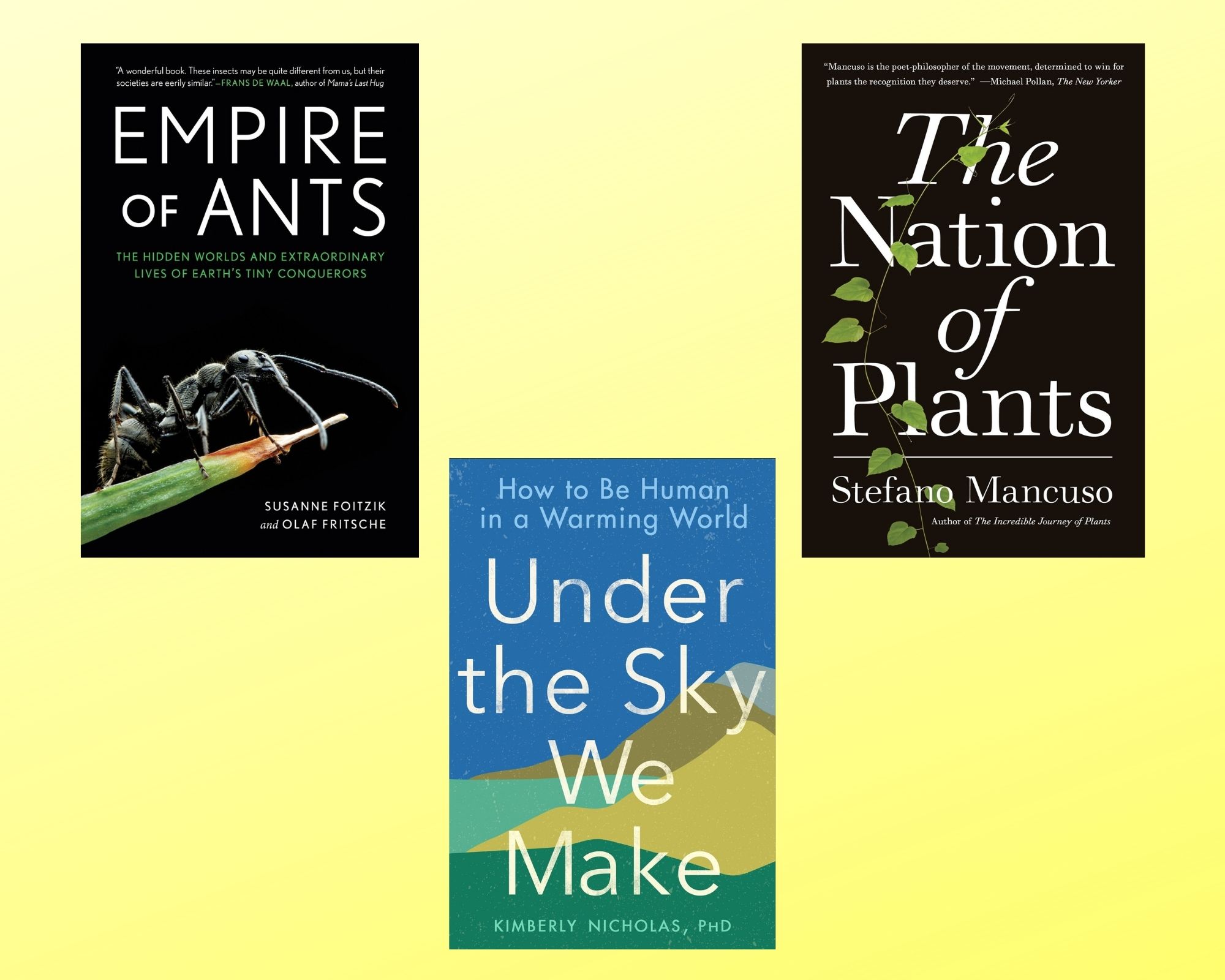
Nonfiction books to read in MarchLook at the World around You
  • Empire of Ants: The Hidden Worlds and Extraordinary Lives of Earth’s Tiny Conquerors by Susane Foizik and Olf Fritshe (The Experiment): Think about this: “Ants number in the ten quadrillions and they have been here since the Jurassic era.” This book introduces us to the quintessential picnic pest, revealing their complex social structure, childrearing practices, and political actions. Audiobook: N/A
  • The Nation of Plants by Stefano Mancuso (trans. Gregory Conti; Other Press): This is an easy-to-read treatise about the importance of plants to our own lives and to the planet. Mancuso outlines the foundational tenets on which plant life depends and reminds us that if we don’t treat plants well, we’ll soon lose their protective and nourishing benefits. Audiobook read by Nigel Patterson (3 hr).
  • Under the Sky We Make: How to Be Human in a Warming World by Kimberly Nicholas (Putnam): If you haven’t noticed that the climate is changing, then you haven’t been outside your house in 10 years or more. In this down-to-earth book you’ll learn that climate change is real, but you’ll also learn that you—yes, you—can make a difference. Nicholas, a climate scientist, tells us just how important it is for each of us to change our behavior: every small change makes a huge difference. Audiobook read by the author (~9 hr).
Nonfiction books to read in MarchMurder through History
  • A Fatal Thing Happened on the Way to the Forum: Murder in Ancient Rome by Emma Southon (Abrams): On the surface, it appears that Ancient Rome had a different relationship with life and death than we do; after all people came out in droves to watch gladiators fight to the death and they murdered their emperors in public view. Employing her sense of humor and an easygoing style, Southon tells all about Roman murder and culture and notes their relevance to modern times. Audiobook read by Sophie Ward (~11 hr).
  • Terror to the Wicked: America’s First Trial by Jury That Ended a War and Helped Form a Nation by Tobey Pearl (Pantheon): In 1638 near Plymouth Colony, a Nipmuc tribesman was robbed and murdered by a white indentured servant. Before he dies, the man reveals the details of the crime and names his killer. This is the story of the ensuing manhunt and the first jury trial by colonizers in the Americas. The case involved famous figures like Myles Standish and everyday citizens who testified before the court and served on the jury. The outcome of this trial had far-reaching consequences for the colonies and the new country to come. Audiobook read by Barrett Leddy (~7 hr).
  • The Babysitter: My Summers with a Serial Killer by Liza Rodman with Jennifer Jordan (Atria): In the 1960s, when her mother worked during the day and danced in Provincetown bars at night, Liza and her sister were in the care of a babysitter: a good-looking, nice man who worked as a hotel handyman. When Liza learned that Tony Costa was arrested for brutal murders, she couldn’t reconcile the nice guy who took her for ice cream with the Cape Cod killer. This is her story of the man, how the knowledge of the murders affected her, and how she ultimately coped. Audiobook read by Andi Arndt and Alda Reluzco (~9 hr).

Click for more

07 August 2020

12 True Stories to Read This Month

Although I seem to be lost in a sea of speculative fiction and mysteries/thrillers during these trying times, I haven’t forgotten that I normally love nonfiction. In fact, I’ve already finished one of the books on this list and have another one in my queue.

If you can’t quite face true stories right now, jot down the titles that call to you and save them for brighter days.

Most of the following books are coming out this month, but please double-check because publishing dates are unreliable this year. Summaries are cobbled from the publishers; audiobook information is included.

Olive the Lionheart, Being Lolita, The Book of Atlantis Black, The Fixed Stars
Life Stories
  • Olive the Lionheart by Brad Ricca (St. Martin’s Press): In 1910, Olive MacLeod, a thirty-year-old, redheaded Scottish aristocrat, received word that her fiancĂ©e, the famous naturalist Boyd Alexander, was missing in Africa. So she went to find him. This is the thrilling true story of her astonishing journey. Based on firsthand sources (letters and diaries). Audiobook: Read by Billie Fulford-Brown; 11 hr 31 min; Macmillan Audio
  • Being Lolita by Alisson Wood (Flatiron): The true story of how the author came under the thrall of her high school English teacher, and it all began when Mr. North gave Allison a copy of Lolita. This is a stunning coming-of-age memoir that shines a bright light on our shifting perceptions of consent, vulnerability, and power. Audiobook: Read by Alisson Wood; 6 hr, 46 min; Macmillan Audio.
  • The Book of Atlantis Black by Betsy Bonner (Tin House): A young woman is found dead on the floor of a Tijuana hotel room. An ID in a nearby purse reads “Atlantis Black.” The police report states that the body does not seem to match the identification, yet the body is quickly cremated and the case is considered closed. So begins Betsy Bonner’s search for her sister, Atlantis, and the unraveling of the mysterious final months before Atlantis’s disappearance, alleged overdose, and death. Using her sister’s online history, the author sets out to find out what happened. This is a haunting memoir and piercing true crime account. Audiobook: Read by Laura Jennings; 5 hr, 15 min; Blackstone.
  • The Fixed Stars by Molly Wizenberg (Abrams): This is the story of how a straight wife and mother discovered that her self-identified sexuality and images of family changed irrevocably after a chance meeting with a woman lawyer. This memoir explores timely and timeless questions about desire, identity, and the limits and possibilities of family. It’s a frank and moving story about letting go of rigid definitions and ideals that no longer fit and of learning instead who we really are. Audiobook: Read by Erin Mallon; 6 hr, 21 min; Dreamscape.
End of Everything, Vesper Flights, Gods of the Upper Air, Leave It as It Is
Science and Nature
  • The End of Everything by Katie Mack (Scribner): An accessible and eye-opening look at five ways the universe could end, and the mind-blowing lessons each scenario reveals about the most important concepts in cosmology. Told with lively wit and humor, this is a wildly fun, surprisingly upbeat ride to the farthest reaches of all that we know. Audiobook: Read by Gabra Zackman; 6 hr, 21 min; Simon & Schuster Audio.
  • Vesper Flights by Helen Macdonald (Grove): A transcendent collection of essays about the human relationship to the natural world “Animals don’t exist in order to teach us things, but that is what they have always done, and most of what they teach us is what we think we know about ourselves.” This is a captivating and foundational book about observation, fascination, time, memory, love and loss and how we make sense of the world around us. Audiobook: Read by Helen Macdonald; 10 hr, 22 min; Recorded Books.
  • Gods of the Upper Air by Charles King (Doubleday): A dazzling history of the birth of cultural anthropology and the adventurous scientists who pioneered it—a sweeping chronicle of discovery and the fascinating origin story of our multicultural world. A century ago, everyone knew that people were fated by their race, sex, and nationality to be more or less intelligent, nurturing, or warlike. But Columbia University professor Franz Boas looked at the data and decided everyone was wrong. Racial categories, he insisted, were biological fictions. His students were some of the century’s most colorful figures and unsung visionaries whose revolutionary findings would go on to inspire the fluid conceptions of identity we know today. Audiobook: Read by January LaVoy; 13 hr, 32 min; Random House Audio.
  • Leave It as It Is by David Gessner (Simon & Schuster): From Theodore Roosevelt’s rallying cry of “Leave it as it is” (referring to the Grand Canyon) to today’s continued environmental fight to save our wild areas, conservation has never gone out of style. This is an account of a nature writer’s retracing of Roosevelt’s steps through the grandeur of our public lands, telling the story of the president’s life as a pioneering conservationist and offering an arresting history, a powerful call to arms, and a profound meditation on our environmental future. Audiobook: Read by Fred Sanders; 12 hr, 24 min; Simon & Schuster Audio.
Berlin 1936, The Craft, Children of Ash and Elm, Iron Empires
History
  • Berlin 1936 by Oliver Hilmes (Other Press; paperback): A lively account of the 1936 Olympics told through the voices and stories of those who witnessed it, from an award-winning historian and biographer. The book takes the reader through the sixteen days of the Olympiad, from the activities in the stadium to the lives of ordinary Berliners, offering a last glimpse of Germany’s vibrant and diverse life, before the Nazis tried to destroy it. Audiobook: no information
  • The Craft: John Dickie (Hachette): The history of the Freemasons and how it influenced history, society, and government around the globe. Yet the Masons were as feared as they were influential. This is an enthralling exploration of a the world's most famous and misunderstood secret brotherhood, a movement that not only helped forge modern society but has substantial contemporary influence, with around six million members across the world. Audiobook: Read by Simon Slater; 16 hr, 35 min; Hachette Audio.
  • Children of Ash and Elm by Neil Price (Basic Books): Written by an archaeologist, this is billed as the definite history of the Vikings told on their own terms: their politics, their cosmology and religion, their material world. Known today for a stereotype of maritime violence, the Vikings exported new ideas, technologies, beliefs, and practices to the lands they discovered and the peoples they encountered and, in the process, were themselves changed. Audiobook: Read by Samuel Roukin; 17 hr, 25 min; Recorded Books.
  • Iron Empires by Michael Hiltzik (HMH): After the completion of the Transcontinental Railroad, America’s railways soon exploded into a titanic industry helmed by a pageant of speculators, crooks, and visionaries. This is an account of the vicious competition between empire builders and how the iconic figures of the Gilded Age, the robber barons, drove the country into the twentieth century—and almost sent it off the rails. Audiobook: Narrator and publisher not yet available; 15 hr, 57 min

Click for more

22 February 2020

Weekend Cooking: Cookbooks on My Mother's Shelves

Weekend Cooking at Beth Fish ReadsOne of the more difficult tasks that children face after their last parent dies is cleaning out their house. My mother was still living in the same four-bedroom, two-story house that we moved to in 1964. Although neither she nor my father was a hoarder, there are still quite a number of personal items that my brothers and I need to look through.

Among my mother's things were dozens of cookbooks. Only one of my brothers is a dedicated cook, so the two of us went through the books, picking out the ones we wanted to take home. Many evoked fond memories and prompted stories about holidays or special occasions, which made our job a little bit lighter.

I ended up taking only seven cookbooks, and that's what's today's Weekend Cooking post is all about.

Lee Bailey

The first four I knew I wanted to find on my mom's shelves were all by Lee Bailey (the food writer, not the attorney). Bailey had a down-to-earth attitude about cooking and used to write a monthly column for Food & Wine magazine. As I said in a post I wrote in 2012:

Bailey's books are known for their beautiful photography, not only of the food but of the table settings, rooms, people, and natural surroundings. I love that his cookbooks are arranged by complete menus. Depending on the book and recipes, he also writes about wine choices, the inspiration behind the meal, the right occasion to serve the meal, and so on.
I'm pretty sure his books are currently out of print, which is why I was happy to find four on my mother's bookshelves. I had a really hard time finding cover images for his books; thus the fuzzy photos below.

Weekend Cooking at Beth Fish Reads
  • City Food (Clarkson Potter, 1984) has menus with such great titles as "On a Ferry," "A Swell, Swell Dinner," "On a Rooftop Terrace," and "In a Painter's Loft." Yet, in true Bailey fashion, the menus are quite accessible. Here's one: Grill tuna with Creole sauce, string beans and mushrooms, oven-baked potato chips, coconut flan, wine, and coffee.
  • Cooking for Friends (Clarkson Potter, 1992) compiles menus from around the world, including the Florida Keys, Gascony, New York City, and Tuscany. One of the Greek menus goes like this: pistachio-coated fish with cucumber sauce, orzo with onions and black olives, baked honey-mint tomatoes, and peach bread pudding with brandy jam sauce.
  • Country Desserts (Clarkson Potter, 1988) breaks from Bailey's signature menus to give us tons of recipes for down-home cakes, cobbles, cookies, ice cream, and pies. The kids' desserts are hardly just for kids and the pound cakes, muffins, tarts, and bread puddings will make your mouth water.
  • Good Parties (Clarkson Potter, 1986) covers the seasons from lazy summer lunches to city birthday parties, warming Sunday roasts, and winter getaways. A Sunday pasta dinner consists of vegetarian pasta with tomatoes and peppers, a lettuce and cheese salad, crusty bread, a peach cake, and wine and coffee.
If you ever see any of Lee Bailey's cookbooks at a yard sale or used book store, don't pass them by. Some of the ideas/meals may be dated, but all his recipes are pretty much guaranteed to succeed.

Thoughts for . . .

Weekend Cooking at Beth Fish ReadsIn the late 1950s and early 1960s, Houghton Mifflin published three cookbooks: Thoughts for Food, Thoughts for Buffets, and Thoughts for Festive Foods (maybe not in that order). My mother used the latter two so much that they no longer have covers, so I had to search the internet for images (which you see to the right). So many of our long-time family favorite dishes came from these cookbooks that I had to have my mother's copies. I love that she wrote in the books and that they are so beaten up. I'm not sure how much I'll cook from these books, but I'm going smile every time I see them on my bookshelf. One puzzle though: Why didn't she own the first cookbook? Hummm.

Knopf Cooks American

Weekend Cooking at Beth Fish ReadsBack in 2011, I wrote about the cookbook series Knopf Cooks American, which was published in the 1980s and 1990s (I think) and covered all kinds of cuisines and regional cooking found in United States, from the Deep South to the Pacific Northwest. I bought at least six books in the series and so was happy to see that my mom had one of the titles I didn't own.

Joan Nathan's Jewish Cooking in America was first published in 1994 and encompasses quite a broad range of flavors and traditions. The subtitle pretty much tells you all you need to know about this cookbook: "A splendid feast of over 300 Kosher recipes, old and new. With stories from Sephardic and Ashkenazic Jews who settled throughout this country." The book is also full of black-and-white family photos that document family meals, celebrations, menus, and restaurants. It doesn't look like my mother ever cooked out of this book, but I did find some recipe clippings tucked in its pages.
_______
Weekend Cooking hosted by www.BethFishReads.comWeekend Cooking is open to anyone who has any kind of food-related post to share: Book reviews (novel, nonfiction), cookbook reviews, movie reviews, recipes, random thoughts, gadgets, quotations, photographs, restaurant reviews, travel information, or fun food facts. If your post is even vaguely foodie, feel free to grab the button and link up anytime over the weekend. You do not have to post on the weekend. Please link to your specific post, not your blog's home page.

NOTE: Mr. Linky sometimes is mean and will give you an error message. He's usually wrong and your link went through just fine the first time. Grrrr.
_______

Click for more

14 February 2020

6 True Stories to Read in February

It's no secret, I love nonfiction. Give me biography, history, nature and travel writing, science and space, and everything else. The true stories that caught my eye this month cover a variety of topics, from the past to the present. Let's take a look.

Troubled History

REview of 1774: The Long Year of Revolution by Mary Beth Norton1774: The Long Year of Revolution by Mary Beth Norton (Knopf, Feb. 11): Written by a respected historian, this is a focused look the critical months of the birth of new nation: "from the Boston Tea Party and the first Continental Congress to the Battles of Lexington and Concord." Norton relies on much firsthand sources and introduces us to figures who don't often appear in school history texts to show that American colonists felt their independence long before the formal declaration was finally signed. First lines:

During the stormy early morning hours of December 11, 1773, a vessel carrying tea and other cargo to Boston wrecked about two miles southeast of Race Point, the northern tip of Cape Cod. On board the William were fifty-eight chests of East India Company tea, fifty-five of which were successfully salvaged. The three damaged chests, each containing about 350 pounds of Bohea (black) tea, remained on the Cape when the other chests were transported later in the month to the safety of the British headquarters at Castle William, an island in Boston harbor. Responding to the sudden arrival of approximately 1,000 pounds of tea on their shores, Cape residents worked to earn it, bought and sold it, argued and fought over it, and destroyed some of it.
Audiobook: Read by Kimberly Farr (Random House Audio; 16 hr, 26 min)

review of Dressed for a Dance in the Snow: Women's Voices from the Gulag by Monika ZgustovaDressed for a Dance in the Snow: Women's Voices from the Gulag by Monika Zgustova, translated by Julie Jones (Other Press; Feb. 4): This volume collects the memories of nine women who were sent to the Soviet labor camps (one to a psych ward) because they or their families were accused of anti-government crimes. The stories are moving, provide eye-witness accounts, and fill some of the gaps in a history that could easily be lost to time. Among the women interviewed is the daughter of Olga Ivinskaya, the woman behind the character of Lara in Doctor Zhivago. The book includes an insert with black-and-white photos. First lines (from introduction):
When the liberation movement known as the Prague Spring ended in August 1968, suppressed by Soviet tanks, and Czechoslovakia was once again under the aegis of the Soviet Union, Soviet authorities began to persecute by father, an eminent linguist, for having participated in the protests in his native Prague. It was then that my parents started to think about fleeing and settling in the US. It wasn't an easy task, because under communism it was illegal to leave the country.
Audiobook: no information

Forensics

review of 18 Tiny Deaths: The Untold Story of Frances Glessner Lee and the Invention of Modern Forensics, by Bruce Goldfarb18 Tiny Deaths: The Untold Story of Frances Glessner Lee and the Invention of Modern Forensics, by Bruce Goldfarb (Sourcebooks, Feb. 4). Written by an investigative journalist who currently works for the chief medical examiner of the state of Maryland, this book introduces us to the woman who, though born in the decade after the Civil War, developed a revolutionary method for investigating crime scenes. Lee, a daughter of Chicago's high society, discovered her passion late in life when she met a medical examiner who told her stories of criminal deaths and bemoaned the fact that most men in his profession were political appointees instead of trained scientists. The book includes photographs. First lines:
Seventeen pathologists and medical examiners, all dressed in dark suits and neckties, sat around a long table in a wood-paneled conference room on the third floor of Building E-1 of Harvard Medical School. It was the autumn of 1944. Thousands of miles away, war ravaged Europe and the Pacific islands. The men had gathered at Harvard to attend a seminar on legal medicine, a field that would later be known as forensic science—the application of medicine to matters of law and justice.
Audiobook: Read by Nan McNamara (Recorded Books, 8 hr, 35 min)

review of American Sherlock: Murder, Forensics, and the Birth of American CSI, by Kate Winkler DawsonAmerican Sherlock: Murder, Forensics, and the Birth of American CSI, by Kate Winkler Dawson (Putnam, Feb. 11): Written by a producer of documentaries, this biography-history mashup tells the story of Edward Oscar Heinrich, who earned the moniker of "the American Sherlock" from his reputation for solving thousand of crimes in the first half of the last century. Based on primary sources, Dawson describes Heinrich's inventions, attention to detail, and "uncanny knack for finding clues." First lines:
His upper jawbone was massive—a long, curved bone with nine tiny holes meant to hold his teeth. The remainder of his skeleton was blackened by a fairly large fire ignited by an anonymous killer. Lifting up the jawbone, I examined the small blades of grass that adhered to its exterior—organic evidence from his hillside grave in El Cerrito in Northern California.
Audiobook: Read by the author (Penguin Audio; 10 hr, 43 min)

Our Feathered Friends

review of The Falcon Thief: A True Tale of Adventure, Treachery, and the Hunt for the Perfect Bird by Joshua HammerThe Falcon Thief: A True Tale of Adventure, Treachery, and the Hunt for the Perfect Bird by Joshua Hammer (Simon & Schuster, Feb. 11): Who knew that the illegal practice of stealing birds' eggs was a thing? This is the true story of Jeffrey Lendrum, who devoted his life to smuggling falcons and falcon eggs from all over the world to sell to the rich, especially in the Mideast. It's also the story of Andy McWilliam from the UK National Wildlife Crime Unit, who was determined to put an end to Lendrum's career. First lines:
The man had been in there far too long, John Struczynski thought. Twenty minutes had elapsed since he had entered the shower facility in the Emirates Lounge for business and first class passengers at Birmingham International Airport, in the West Midlands region of England, 113 miles north of London. Now Struczynski stood in the corridor outside the shower room, a stack of fresh towels in the cart beside him, a mop, a pail, and a pair of caution wet floor signs at his feet. The janitor was impatient to clean the place.
Audiobook: Read by Matthew Lloyd Davies (Simon & Schuster Audio, 8 hr, 23 min)

review of White Feathers: The Nesting Lives of Tree Swallows by Bernd HeinrichWhite Feathers: The Nesting Lives of Tree Swallows by Bernd Heinrich (Houghton Mifflin Harcourt, Feb. 18): Written by a naturalist, this book starts with a simple question: Why do the  tree swallows in the author's yard line their nests exclusively with white feathers, even though they're not abundant near his New England home? This led to years of observations and non-intrusive experiments into tree swallow nesting behavior. The book contains photos and drawings and looks perfect for those of us who are curious about birds, animal behavior, and nature. First lines:
There is arguably no bird in the world that combines graceful flight, beauty of feathers, pleasing song, and accessibility, plus tameness and abundance, more than the tree swallows (Tachycineta bicolor). And just by putting up a nest-box made in minutes from some scrap board and placed on a pole, I had a pair nesting by my door. In early May 2008, I happened to peek into the nest-box and saw five snow-white eggs in a bed of long white feathers. I had peeked into nest-boxes before and seen nest linings of various commonly available materials, but never anything like this. It was no fluke—such white feathers are rare, and it had cost the swallows deliberate effort to search for and acquire them.
Audiobook: Ready by Rick Adamson (Houghton Mifflin Harcourt, 7 hr, 10 min)

*All books (digital, print, and/or audio) provided by the publishers. Descriptive quotes taken from the publisher's summaries; descriptions derived from the publishers, skimming the books, and reading reviews. Some first lines taken from advanced reader copies.

Click for more

14 June 2019

Starting from Page 1: Which June Book Is for You?

It's been a really long time since I've done a Starting from Page 1 post (as in a few years), but so many of my June books have great opening sentences, I just had to revisit this feature.

Today I share the opening lines from 9 general fiction books published this month. All of them caught my eye, and I'm not quite sure which to read first. (Okay, that's a little bit of a lie, because I think I know what I'll be reading next. Can you guess?)

Just for fun, I'm giving you the bare minimum information for each title. Based only on the first lines, which ones are calling your name?

What to read in June 2019
FKA USA by Reed King (Flatiron); dystopian; humor; comp'd to everything from Hitchhiker's Guide to the Galaxy to Wizard of Oz!
" 'There,' Jared Lee, the first of my two and a half friends, pointed past the stubby line of waste-treatment plants. 'Right there. See? Refugees.' "
How Could She by Lauren Mechling (Viking); set in New York and Toronto; 21st-century issues
"Geraldine considered her grapefruit."
Lifelines by Heidi Diehl (Houghton Mifflin Harcourt); set in Oregon & Germany; family, relationships, motherhood
"Louise was a passenger in her own car."
What to read in June 2019
The Summer We Lost Her by Tish Cohen (Gallery); comp'd to two of my favorite books: Deep End of the Ocean & Map of the World
"It was one of those things that never should have happened--the kind you turn over, splay open with pins, and examine at intervals for the rest of your life because it will never, ever cease to matter."
A Family of Strangers by Emilie Richards (Mira); sisters; buried past; redemption
"What do alligators dream about?"
The Islanders by Meg Mitchell Moore (William Morrow); a beach read set on Block Island
" 'It was disconcerting, to see a man cry like that,' said Bridget Fletcher"
What to read in June 2019
The Tenth Muse by Catherine Chung (Ecco); mathematics; family history & secrets
"There is nothing as intriguing as a locked door."
This Is Home by Lisa Duffy (Atria); set in Boston; coming of age
"The year I turned ten, my father shot the aboveground pool in our backyard with his police-issued pistol."
The Great Unexpected by Dan Mooney (Park Row); aging; friendship; maintaining independence
" 'Miller,' Joel whispered across the space between their two beds. 'Why aren’t you dead yet?' "

Click for more

10 May 2019

8 True Stories to Read This Month

Do you have genres you just can't say no to? I do, and one of them is nonfiction.As you may have noticed, I've been on a true-story kick lately. Lucky me, because May is full of great new nonfiction of all types. I tried to restrain myself, but I couldn't resist the list I'm sharing today. Memoirs, history, architecture, crafting, biography, and the outdoors--bring it on!

Here's just some of my nonfiction list for this month. I've already read some of the books featured here (see next Monday's post), but others are still to come.

Biography

review of Becoming Dr. Seuss: Theodor Geisel and the Making of an American Imagination by Brian Jay JonesDo you like green eggs with ham? Or will you not eat them here or there, will not eat them anywhere? If you know what I'm talking about then you'll want to pick up a copy of Becoming Dr. Seuss: Theodor Geisel and the Making of an American Imagination by Brian Jay Jones (Dutton, May 7). I sure hope all of you grew up with Dr. Seuss. When I was very small, I loved his books and poems and illustrations. He was publishing some of his most famous books (Green Eggs and Ham, The Cat in the Hat) when I was learning to read, and even though I know most of his work from the 1950s and early 1960s, I don't know anything about the man who created the Grinch. I'm looking forward to discovering the arc of his life and career, and I trust Jones to do Seuss right. First line: "On paper, Mulberry Street doesn't look like much." Audiobook: Read by Mike Chamberlain (Penguin Audio, 18 hr)

review of CNN's Anthony Bourdain RememberedWhen I was in college I had a half dream of opening a restaurant. Fortunately (or maybe not), I woke up and went on to become a few other something elses. I still love cooking for others, even all these years later. I also still remember when I read Kitchen Confidential. It's hard to believe that was almost 20 years ago, but I've followed Anthony Bourdain ever since. I was so sorry to hear about his death by suicide last year, but I'm glad to have a chance to revisit him in CNN's Anthony Bourdain Remembered (Ecco, May 28). This book is not a memoir but a collection of photographs and tributes, stories and memories from his friends, fans, and acquaintances. It's beautifully put together and will tug at your heart. It will also make you want to travel and to eat! First line: "When we met Tony for the first time in 2012 to discuss developing and hosting our first CNN Original Series, he explained that he did not consider himself a journalist." Audiobook: none.

Curious Minds

review of The Pioneers: The Heroic Story of the Settlers Who Brought the American Ideal West by David McCulloughHere's another thing about me: despite the hardships and dangers, I'm forever sorry that I was not around during the pioneer days of the American West. I've read quite a few firsthand accounts of the journey from St. Louis to parts unknown so it comes as no surprise that The Pioneers: The Heroic Story of the Settlers Who Brought the American Ideal West by David McCullough (Simon & Schuster, May 7) is on my list. I'm kind of saving this book for deck-reading weather, thinking I'll do an alternating read and listen--one of my favorite ways to read history. McCullough starts in the late 1780s with the settling of Ohio country and ends just short of a 100 years later in the aftermath of the Civil War. The print/digital book has maps and photo inserts, which I'll look at while I'm listening. First line: "Never before, as he knew, had any of his countrymen set off to accomplish anything like what he had agreed to undertake—a mission that, should he succeed, could change the course of history in innumerable ways and to the long-lasting benefit of countless Americans." Audiobook: Read by John Bedford Lloyd (Simon & Schuster Audio; 10 hr, 23 min)

REview of Suzanne Hinman's The Grandest Madison Square Garden: Art, Scandal, and Architecture in Gilded Age New York Whenever I visit a new place, especially a big city like New York City, I love looking at the buildings. My eye, and my camera, are drawn to the details: the muntin patterns, the shape of the brackets and braces, the adorning statues, and the stonework. Did you know that the current Madison Square Garden--that round, rather nondescript building above the train station--is actually the third arena to grace that corner? Suzanne Hinman's The Grandest Madison Square Garden: Art, Scandal, and Architecture in Gilded Age New York (Syracuse University Press, May 15) is all about building two, completed in 1890. How I would have loved to see that tower, topped with the shining nude sculpture of the goddess Diana. Oh the shock! This book introduces us to the architects and visionaries who build the Garden and places the entire project in the context of the city and the splendors and excesses of the Gilded Age. Period photographs and maps are found throughout the book. First line (prologue): "New York City, 'the diamond stickpin on the shirtfront of America.' " Audiobook: none

Women's Stories

review of Wild Horses of the Summer Sun: A Memoir of Iceland by Tory BilskiAs you might have guessed by the number of books I read set in cold, sparsely populated places, I love the northern climes. I've never been to Iceland, but if I visit, it's the northern tip I'm interested in. In Wild Horses of the Summer Sun: A Memoir of Iceland (Pegasus Books, May 7), Tory Bilski describes her love of horses and life on a remote farm far away from the stresses of the modern world. Each June, Bilski and a few other women move to Iceland to spend the long summer days with Icelandic horses and with each other. Although married and working at Yale, Bilski finds a deep sense of her inner self and a connection to nature when on horseback in this wild area of the world. Over the years, the women have gotten to know each other, sharing their joys and sorrows and finding strength in their joint commitment to the horses and their growing friendship. The print/digital copy includes color photos. First Line: "First time, right off the bat, years before the technical advantages of GPS or iPhones, we get lost." Audiobook: none

review of Dear Scarlet by Teresa WongYou know how if it's a woman's problem then no one talks about it? I'm reassured in this new(ish) century that things are changing. Menopause has emerged from taboo land, and now so has postpartum depression. It's real, and until recently women kept their sorrows and struggles private. Modern mothers are telling their stories, offering empathy and support to others who suffered from PPD. In her graphic memoir, Dear Scarlet (Arsenal Pulp, May 7) Teresa Wong writes honestly and frankly about the darkness that overcame her after the birth of her first child. Wong sets her memoir up as a letter to her daughter and writes about thinking she wasn't a good enough mother and of feeling overwhelmed. Despite getting domestic help, seeing a therapist, and accepting support from her family, she could not find the light within. Wong's journey ultimately turns out okay, offering hope to other new mothers. The black and white drawings nicely convey Wong's roller-coaster emotions. First line: "The other day, you told me that when you grow up, you want to be a mommy." Audiobook: none.

Men's Stories

review of Jonathan Gornall's How to Build a Boat: A Father, His Daughter, and the Unsailed SeaDid you know that I come from a sailing family? My parents had a boat that they sailed on the Great Lakes pretty much all the way up to the day my father died. My mother was a freelance journalist, and boats and sailing were her beat. One of my cousins built a boat or two, and one of our closest friends has also built seaworthy small boats. Thus Jonathan Gornall's How to Build a Boat: A Father, His Daughter, and the Unsailed Sea (Scribner, May 7) caught my eye. In his memoir, Gornall talks about his unlikely decision to build a wooden Viking-style small boat for his newborn daughter. This venture led him to learn about wood, about boats, about tools, and about becoming a better father this second time around. Throughout he also talks about his own childhood, his relationship with his grown son, and his (sometimes failed) experiences on the open water. First line: "There are, I suppose in my ignorance, two foolproof ways to find out if a newly built wooden boat is watertight." Audiobook: Read by the author (Simon & Schuster, 9 hr, 22 min)

review of John Connell's The Famer's SonI grew up in farm country, and though I moved to a different state, I still make my home in (dwindling) farm country. I've never, however, been a farmer. John Connell grew up on a farm in Ireland, but he spent his early adulthood away from home, earning his way as a filmmaker and journalist. The call of the land finally became too strong to ignore, and he returned home. The Farmer's Son: Calving Season on a Family Farm (Houghton Mifflin Harcourt, May 7) is his story of homecoming, of reconnecting to Ireland, of the endless farm chores, of tending to the animals, and of living under the scrutiny of his father. The work is physically demanding and living with his father is rocky, but Connell notices a lifting of his blues as he settles back into the community and finds a place among the animals under his care and on the land that nurtured generations of his family. First line: "I’m twenty-nine and I’ve never delivered a calf myself." Audiobook: Read by Alan Smyth (Highbridge, 7 hr, 56 min)

Need More?

Here are a few more books I really want to read:

  • Unspeakable: The Things We Cannot Say by Harriet Shawcross (Canongate, May 7): A multi-perspective look at silence
  • The Walking Life: Reclaiming Our Health and Our Freedom One Step at a Time by Antonia Malchik (De Capo, May 7): An anthropological, sociological look at human locomotion
  • Every Tool's a Hammer: Life Is What You Make It by Adam Savage (Atria, May 7): A maker's life.
  • How to Think Like a Fish: And Other Lessons from a Lifetime in Angling by Jeremy Wade (De Capo, May 21): A life lived in the outdoors.

Click for more

05 April 2019

10 Books About Ourselves and Our World

I'm an eclectic reader. My shelves contain a healthy mix of literary fiction, fantasy, mystery, and even middle grade novels. Sitting right next to all of that escape reading are a good number of true stories, science, history, essays, and biography. These days, I doubt I could name just one genre or subject as my favorite, but when I was in elementary school, I used to tell people that biography was my go-to.

Today's roundup highlights the nonfiction titles I've added to my April reading list. I know I won't get to all of these, but the following 10 books are the ones that caught my attention. The list contains biography, history, science, personal essays, and memoir, so I hope something here will find its way to your own bookshelves. Note that I'm not including food writing/memoir, which I'll save for my Weekend Cooking posts.

Science

  • 10 nonfiction books to read in April 2019The Accidental Homo Sapiens: Genetics, Behavior, and Free Will by Ian Tattersall and Robert DeSalle (Pegasus Books; April 2). This book examines human evolution from a contemporary theoretical context, looking at the interplay of genetics and behavior, the way humans solve problems and change their environment, and the biological future of our species. Why I want to read this: Tattersall was youngish paleontologist, already making a name for himself, when I was in graduate school. He and DeSalle are both associated with the American Museum of Natural History and are well respected in the fields of physical anthropology and evolution. This topic is closely related to my own academic interests.
  • American Moonshot: John F. Kennedy and the Great Space Race by Douglas Brinkley (Harper, April 2). I can't summarize this better than the following sentence from the publisher: "A vivid and enthralling chronicle of one of the most thrilling, hopeful, and turbulent eras in the nation’s history, [this book] is an homage to scientific ingenuity, human curiosity, and the boundless American spirit." Why I want to read this: First--gawk!--it cannot possibly be 50 years since we first landed on the moon; it was 20 years ago tops, right? I'm particularly interested in this account because it includes new interviews and firsthand accounts of the politics, people, and technology that allowed JFK's challenge to be met ahead of schedule.
  • Science Comics: Wild Weather: Storms, Meteorology, and Climate by M. K. Reed and illustrated by Jonathan Hill (First Second, April 16). This book helps us learn to distinguish between weather and climate and tells us all about new weather technology and how major storm systems develop. This fun nonfiction comic answers all our questions about storms throughout the seasons. Why I want to read this: I'm curious about the world around me and love the idea of learning more about weather through a nonfiction comic. This may be geared to middle grade readers, but I'm sure I'll discover something new about meterology.
Essays
  • 10 nonfiction books to read in April 2019Greek to Me: Adventures of the Comma Queen by Mary Norris (Norton, April 2). Norris is widely known as the chief copyeditor of The New Yorker magazine and in this collection of essays she talks about English, words, and her love affair with all things Greek. Why I want to read this: As an avid reader, full-time copyeditor, and part-time book reviewer how could I say no to this? Norris is not only an impeccable editor but an entertaining and thoughtful writer. This is (as you might have guessed) on my must-read list for this month.
  • Here Is Where I Walk: Episodes From a Life in the Forest by Leslie Carol Roberts (University of Nevada Press, April 3). In the essays collected here, Roberts muses about travel, nature, motherhood, and the environment, all linked by the time she has spent in America's only residential national park, the Presidio in San Francisco. Why I want to read this: I'm a big walker and love to spend as much time as possible in my local parks and state forests. I wonder if Roberts and I think about the same kinds of things when we're in the woods.
Humor
  • 10 nonfiction books to read in April 2019The Field Guide to Dumb Birds of North America by Matt Kracht (Chronicle Books, April 2). Do you think you can you identify the common birds that hop around your yard and build nests in your hanging plants? Kracht bets you don't know their real names: how about the black-capped prickadee and goddamned Canada goose? Why I want to read this: I love watching the birds in my yard and tending to my bird feeders, but I also have a good sense of humor. This guide offers solid information about our feathered friends but it's served with an irreverent attitude. The illustrations (see the cover) are nicely done.
  • Fifty Things That Aren't My Fault by Cathy Guisewite (Putnam, April 2). In this collection, Guisewite steps away from her beloved comic strip (Cathy) to talk about life and family in the sandwich years and her complex perspectives on grown children, aging parents, and retirement. Why I want to read this: I've always been a huge Cathy fan and, hey, Guisewite and I are about the same age, so I can relate. I love her viewpoint.
  • Southern Lady Code: Essays by Helen Ellis (Doubleday, April 16). In her newest collection of essays, Ellis talks about, as the publisher says, "marriage and manners, thank-you notes and three-ways, ghosts, gunshots, gynecology, and the . . . art of living as a Southern Lady." Why I want to read this: Even though I'm a Yankee through and through, I'm a fan of Ellis's outlook on life. In her new book, she offers a fresh angle on being a displaced southern belle in the modern world. I'm ready to laugh.
History
  • 10 nonfiction books to read in April 2019The Five: The Untold Lives of the Women Killed by Jack the Ripper by Hallie Rubenhold (Houghton Mifflin Harcourt, April 9). Much has been written about Jack the Ripper, a murderer who has never been definitively identified. But who were the women he killed? What were their stories? Why I want to read this: I like true crime and want to know more about the victims whose names and lives have been overshadowed by the man who killed them. A snapshot of the dark side of the Victorian era by a historian.
  • The Regency Years: During Which Jane Austen Writes, Napoleon Fights, Byron Makes Love, and Britain Becomes Modern by Robert Morrison (Norton, April 30). The Regency period provides an endless source of interest and is pretty much summed up by the book's subtitle. Ocean battles, global trade, the arts, new technology, and changing politics; it was a vibrant and not always pretty era. Why I want to read this: Some of my favorite authors published during this time and some of my favorite novels were set during this time. Plus I love history and always appreciate an accessible and easy-to-read account of the past.

Click for more

15 March 2019

6 Books in Translation to Read in March

It's the ides of March, and the only thing I have to beware is letting time get away from me and missing some of this month's books in translation. As you well know, I make an effort to read authors who are outside the English-speaking world. It's a great way to gain a different perspective and to learn about life around the globe.

Here are six books in translation on my March reading list. They cover a range of genres, and I hope at least one catches your eye.

review of All Happy Families: A Memoir by Hervé Le TellierAll Happy Families: A Memoir by Hervé Le Tellier, translated from the French by Adriana Hunter (Other Press, March 26). In this moving memoir, Le Tellier recalls his childhood, spent mostly with his grandparents or troubled mother, and the years in which he seemed unable to feel normal human emotions, such as grief and love. Although he wasn't abused, his relationships with the people who were meant to protect him were often beyond dysfunctional. His mother in fact suffered from a disconnection to reality and often lied to him. Other people he was close to died early, including a girlfriend, which is another form of abandonment. In this memoir, Le Tellier comes to terms with these difficult relationships as he views them through the lens of maturity and success as a writer. A testament to the fact that children can indeed survive messed-up families.

review of Auntie Poldi and the Vineyards of Etna by Mario GiordanoAuntie Poldi and the Vineyards of Etna by Mario Giordano, translated from the German by John Brownjohn (Houghton Mifflin Harcourt, March 5). I don't know how I missed the first book in this series, but I'm happy to jump on the Auntie Poldi bandwagon with the second book. When Isolde Oberreiter, better known as Poldi, left Germany to spend her retirement in Sicily, she had no idea that there'd be more to life than walks on the beach, copious glasses of wine, occasional sex, and new friends. Poldi can't help but get involved when it's a matter of dead body or two. In this outing, the unstoppable Poldi is determined to figure out who poisoned her neighbor's dog. After a little pillow talk with her current lover (a police inspector), she's onto bigger things--like linking the murder of a man to the demise of the dog. An adult cozy mystery brimming with the flavors and colors of Sicily.

review of Homeland: A Novel by Fernando Aramburu,Homeland: A Novel by Fernando Aramburu, translated from the Spanish by Alfred Macadam (Pantheon, March 5). This timely novel is set in Basque country, and although a murder is at its center, this is not crime fiction. Instead, it's an examination of how ordinary people can get caught up in the wider political events of their country and how it isn't always easy to figure out who is hero and who is villain. When a businessman is killed by separatists, the repercussions are felt by more than just the grieving family. Friendships and everyday life in the town are forever changed. Who is brave enough or sure enough to take a stand on the future of Basque? Is it easier just to leave your home and start over? Set after the ETA separatists declare an end to their fight for independence, this story looks at the violent past and uneasy present. The novel has won multiple international honors.

review of The Little Girl on the Ice Floe by Adélaïde BonThe Little Girl on the Ice Floe by Adélaïde Bon, translated from the French by Tina Kover (Europa, March 19). This is a tough memoir about surviving a childhood rape. When she was just nine years old, Bon was raped by a stranger, and though she was unable to provide many details, her parents reported it to the authorities. As a way to cope, Bon compartmentalized her life--seemingly stable and friendly on the outside, while dealing with guilt, shame, fear, and more on the inside. Despite years of therapy and various self-soothing activities (such as eating and drinking too much), there were parts of her that remained numb and details of her attack that she could not remember. Two decades later, the Paris police inform her that they've caught a serial sexual offender, who is charged with dozens of assaults on minors. Only nineteen now-grown women confront the man in court, Bon among them. The aftermath of the trial brings some unexpected reactions. Can there ever be true healing after rape? Especially in a society that still blames the victim.

review of The Secret Wisdom of Nature by Peter WohllebenThe Secret Wisdom of Nature by Peter Wohlleben, translated from the German by Jane Billinghurst (Greystone Books, March 5). I loved Wohlleben's The Hidden Life of Trees (though I can't believe I never wrote about it on my blog), and in his latest, the German forester returns to tell us (as the subtitle says) about "Trees, Animals, and the Extraordinary Balance of All Living Things" through "Stories from Science and Observation." Wohlleben has spent most of his life in the woods, both professionally and privately, observing nature up close and in a way few of us have an opportunity to do. Here he takes a big-picture view of the environment, from the largest forest fires to the smallest insects and discusses in everyday language and using a personable style how the ecosystem works. There are many sides to every problem in a system as complex as Earth's natural world, and Wohlleben takes some surprising stands on conservation and preservation. If you haven't yet read any of his work, you should.

review of Waiting for Bojangles by Olivier BourdeautWaiting for Bojangles by Olivier Bourdeaut, translated from the French by Regan Kramer (Simon & Schuster, March 19). This debut novel, which has already won much critical acclaim, tells the story of an unnamed boy and his unconventional parents who live in happy chaos in Paris. Told mostly from the boy's point of view, with sections from his father's diary, the book follows the mother's journey from quirky to the can-no-longer-deny-it mentally unstable. After the pesky business of taxes and the outside world invade their space, the family removes to a vacation home in Spain, where son and husband hope to protect the ailing woman, showering her with love. Mental illness, however, cannot always be cured with the peace of the countryside, fancy cocktails, and dancing to the record player. The ministrations of well-intentioned family are often not the answer. This coming-of-age story is told partly in verse.

Click for more

18 February 2019

Stacked-Up Book Thoughts: A Great Reading Week

recommended audiobooksI've reached that point where cabin fever is starting to set in. The sleet or ice or cold or snow has kept me cooped up inside and made me miss way too many outdoor walks. It's driving me crazy!

We finally started the new season of True Detective. I like it but need to see a few more episodes before commenting. We finished the Netflix series You, which started out strong, but I was less enamored by the end. We also finally watched the movie Room, which I liked. It's been too long since I read the book to make detailed comparisons, but the young actor who played Jack did an excellent job.

Here's what I read last week.

review of The Raven Tower by Ann LeckieThe Raven Tower by Ann Leckie (Orbit, Feb. 26): I really liked this epic fantasy--told in a mix of first and second person--about gods and humans, sons and fathers, how power travels through the world. As other reviewers have noted, some of the plot lines are similar to Hamlet (a young man returns from war to find his father dead and his uncle on the throne), but much is unique. The god Strength and Patience of the Hill has witnessed eons of the world's history and the rise of humans. Through Strength's narration we learn about the ancient gods, how they gain (and lose) power, where that power lies, what they can (and cannot do), their relationships with each other, and their complex connections with people. At the same time, we are following the political and religious goings on in the kingdom of Iraden. I was intrigued by Leckie's take on the world of the gods, which is different from that of Roman and Greek mythology. In The Raven Tower universe, gods must think carefully before they speak, because their words have the power to change the world and to change their own fate. I was also caught up in the court politics and how the paths of the gods and the humans were intertwined. Don't miss this one. I listened to the unabridged auidobook (Hachette Audio; 12 hr, 2 min) read by Adjoa Andoh, who does a brilliant job conveying the emotional depth of Strength and Patience of the Hill and the god's reactions to all it witnesses throughout the millennia. (audiobook provided by the publisher)

Review of Good Riddance by Elinor LipmanGood Riddance by Elinor Lipman (Houghton Mifflin Harcourt, Feb. 5): In a fit of Kondo-inspired tidying up, Daphne Maritch throws her late-mother's annotated high school yearbook into the recycling bin. In 1968 in a small New Hampshire town, Daphne's mom, June, was a teacher and the yearbook adviser; from that time on, she never missed a reunion of that class, updating her copy of the yearbook with the juicy tidbits of gossip and facts she learned each year. After Daphne's documentary-filmmaker-wantabe neighbor retrieves the yearbook, Maritch family secrets begin to leak out. This is a light, fun contemporary story of a young woman trying to find her place in the world and in New York. Her widowed father, snobby older sister, and various apartment building neighbors have parts to play as Daphne learns that her mother may not have been perfect and that her parents' loving marriage may have had some cracks. Pop culture, humor, and desperate acts keep the plot moving. Unfortunately one of the principal motivators for the entire novel is based on genetics, and the author got those genetics wrong. If I hadn't been listening to this book for a freelance assignment, I would have quit right there. The non-geneticists among you will enjoy this lighthearted novel. The unabridged audiobook (Dreamscape; 8 hr, 7 min) was very nicely read by Mia Barron, whose expressive performance brought out the humor and tapped into the characters' emotional journeys. (audiobook provided for a freelance assignment).

Review of The River by Peter HellerThe River by Peter Heller (Knopf, March 5): I love Peter Heller, and this novel was one of my most anticipated books of the year. I was not disappointed, and The River is now sitting pretty as the best book I've read in a long while. This is the story of Wynn and Jack, both outdoorsy and from rural backgrounds, who meet at college and become best friends. They spend as much time as possible canoeing rivers, fly-fishing, and camping. They have a natural and respectful interpersonal rhythm, and easily travel and work together. While on a canoe trip in Canada, they notice the signs of a not-so-distance forest fire and thus decide to make haste to their take-out point. On that foggy morning they pass two other sets of campers: a pair of drunken older men who mock the boys and a couple camped on an island who can be heard arguing. From that point on the trip takes a dark turn as the boys' safety seems to be jeopardized along more than one front. I love how Heller conveys what it's like to be on a wilderness river--the sights, sounds, work, conditions--and his obvious passion for and knowledge of fly fishing shines. Heller is a master at creating a creeping buildup of danger, holding it just out of sight so you never quite know where and when or if it will manifest. I was completely connected to Wynn and Jack and understood what moved them, what made them who they were. Do not miss this one. (copy provided for a freelance assignment)

Review of Enchantee by Gita TreleaseEnchantee by Gita Trelease (Flatiron, Feb. 5): I already wrote about this nicely done alternate history look at pre-revolutionary France and the intrigues of Louis XVI and Marie Antoinette's court. Camille has inherited the gift of magic from her mother and the printer's trade from her father, but her apprenticeships are cut off when both parents die from smallpox in the late 1780s. Her older brother fails to offer Camille and their younger sister protection, leaving the girls on their own in a Paris that isn't kind to the poor or to girls. Realizing she must use whatever power she has, Camille dons her mother's enchanted dress and infiltrates Versailles, hoping her magic will help her win at cards and rise from poverty. The only trouble is that the magic of the dress lasts only so long, life at court is much more complicated than Camille is prepared for, and she is not the only magician in the palace. In some ways Enchantee is a Cinderella retelling: through magic, a poor girl is transformed, goes to court, and turns heads; but she must leave before her disguise falls apart. I always like a fairy tale retelling and enjoyed those aspects of Enchantee. I also liked the historical facts and period details of Paris: the rumblings of revolution, the storming of the Bastille, the attitudes of the rich, the fashions of court, and the new technology of hot-air ballooning. There were few surprises in Enchantee, but the ending was both exciting and satisfying. I listened to the unabridged audiobook (Macmillian Audio, 12 hr, 56 min) read by Justine Erye, who is one of my go-to narrators. She did an excellent job with the various accents and distinguishing among the characters. (print copy provided by the publisher; audio copy provided for a freelance assignment)

Mercy by Mandeliene Smith, from Rutting Season"Mercy" by Mandeliene Smith from Rutting Season (Scribner, Feb. 12). This week's short story comes from a debut collection. "Mercy" is set on a small family farm, where May is coping with sudden widowhood and the stresses of being a single mother solely in charge of keeping everything on track. The farm was her idea; her husband was a lawyer who gamely agreed to keeping animals, especially Pam's beloved horses. The emotional and dramatic aspects of the story were strong but realistic, and I could sense just how hard it was for Pam to move through her new reality while trying to present a strong and upbeat front for her young children. I will be reading more from this collection; the stories are billed as being about women and families on the brink of transformation. (digital copy provided by the publisher)

Click for more

Copyright

All content and photos (except where noted) copyright © cbl for Beth Fish Reads 2008-2020. All rights reserved.

Quantcast

Thanks!

To The Blogger Guide, Blogger Buster, Tips Blogger, Our Blogger Templates, BlogU, and Exploding Boy for the code for customizing my blog. To Old Book Illustrations for my ID photo. To SEO for meta-tag analysis. To Blogger Widgets for the avatars in my comments and sidebar gadgets. To Review of the Web for more gadgets. To SuziQ from Whimpulsive for help with my comments section. To Cool Tricks N Tips for my Google +1 button.

Quick Linker

Services

SEO

  © Blogger template Coozie by Ourblogtemplates.com 2008

Back to TOP